Substitute \( x = 3i \) into the expression \( \frac{x^2 + 19}{2 - x} \).
Calculate \( x^2 \) where \( x = 3i \). Recall that \( i^2 = -1 \), so \( (3i)^2 = 9i^2 = 9(-1) = -9 \).
Substitute \( x^2 = -9 \) into the numerator: \( x^2 + 19 = -9 + 19 \).
Simplify the numerator: \( -9 + 19 = 10 \).
Substitute \( x = 3i \) into the denominator: \( 2 - x = 2 - 3i \).
Verified video answer for a similar problem:
This video solution was recommended by our tutors as helpful for the problem above
Video duration:
4m
Play a video:
0 Comments
Key Concepts
Here are the essential concepts you must grasp in order to answer the question correctly.
Complex Numbers
Complex numbers are numbers that have a real part and an imaginary part, expressed in the form a + bi, where 'a' is the real part and 'b' is the imaginary part multiplied by the imaginary unit 'i', which is defined as the square root of -1. Understanding complex numbers is essential for evaluating expressions that involve imaginary units, such as substituting x = 3i in the given expression.
Polynomial evaluation involves substituting a specific value into a polynomial expression to compute its value. In this case, the expression x² + 19 / (2 - x) is a polynomial that needs to be evaluated at x = 3i. This process requires careful handling of both the real and imaginary components of the expression.
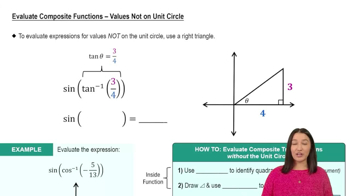
Evaluate Composite Functions - Values Not on Unit Circle
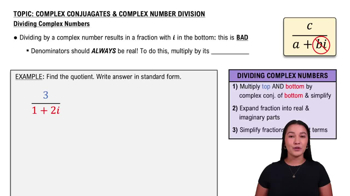
Division of Complex Numbers
When dividing complex numbers, it is important to simplify the expression by multiplying the numerator and denominator by the conjugate of the denominator. This helps eliminate the imaginary unit from the denominator, making the expression easier to interpret. In the context of the given question, understanding how to handle division involving complex numbers is crucial for arriving at the correct result.