In Exercises 1–10, perform the indicated operations and write the result in standard form. (7 + 8i)(7 − 8i)
Ch. 5 - Complex Numbers, Polar Coordinates and Parametric Equations

All textbooks
Blitzer 3rd Edition
Ch. 5 - Complex Numbers, Polar Coordinates and Parametric Equations
Problem 5.1.57
Blitzer 3rd Edition
Ch. 5 - Complex Numbers, Polar Coordinates and Parametric Equations
Problem 5.1.57Chapter 5, Problem 5.1.57
In Exercises 53–58, perform the indicated operation(s) and write the result in standard form. ___ ___ 5√(−16) + 3√(−81)
Verified step by step guidance1
Recognize that the expressions involve square roots of negative numbers, which means we are dealing with imaginary numbers. Recall that \(\sqrt{-a} = \sqrt{a} \times i\), where \(i\) is the imaginary unit with the property \(i^2 = -1\).
Rewrite each term by separating the negative sign inside the square root: \(5\sqrt{-16} = 5 \times \sqrt{16} \times i\) and \(3\sqrt{-81} = 3 \times \sqrt{81} \times i\).
Calculate the square roots of the positive numbers: \(\sqrt{16} = 4\) and \(\sqrt{81} = 9\), so the terms become \(5 \times 4 \times i\) and \(3 \times 9 \times i\) respectively.
Multiply the coefficients: \(5 \times 4 = 20\) and \(3 \times 9 = 27\), so the expression is now \$20i + 27i$.
Combine like terms (both are imaginary terms) by adding the coefficients: \$20i + 27i = (20 + 27)i\(, which simplifies to \)47i\(. This is the expression in standard form, where the real part is 0 and the imaginary part is \)47i$.

Verified video answer for a similar problem:
This video solution was recommended by our tutors as helpful for the problem above.
Video duration:
3mWas this helpful?
Key Concepts
Here are the essential concepts you must grasp in order to answer the question correctly.
Complex Numbers and Imaginary Unit
Complex numbers include a real part and an imaginary part, where the imaginary unit 'i' is defined as √−1. When dealing with square roots of negative numbers, express them in terms of 'i' to simplify and perform operations.
Recommended video:
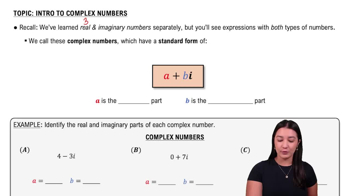
Introduction to Complex Numbers
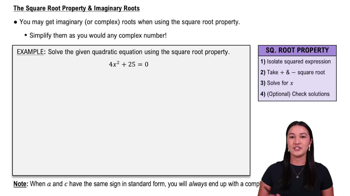
Simplifying Square Roots of Negative Numbers
To simplify √−a, rewrite it as √a × √−1, which equals √a × i. For example, √−16 becomes 4i. This allows you to convert roots of negative numbers into imaginary numbers for further calculation.
Recommended video:
Imaginary Roots with the Square Root Property
Standard Form of Complex Numbers
The standard form of a complex number is a + bi, where 'a' is the real part and 'b' is the coefficient of the imaginary part. After performing operations, express the result in this form for clarity and consistency.
Recommended video:
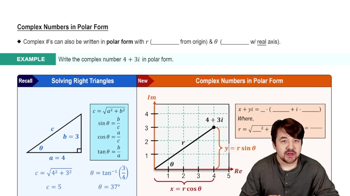
Complex Numbers In Polar Form
Related Practice
Textbook Question
676
views
Textbook Question
In Exercises 59–74, convert each polar equation to a rectangular equation. Then use a rectangular coordinate system to graph the rectangular equation. r = 4 csc θ
912
views
Textbook Question
In Exercises 1–8, add or subtract as indicated and write the result in standard form. 6 − (−5 + 4i) − (−13 − i)
921
views
Textbook Question
In Exercises 49–58, convert each rectangular equation to a polar equation that expresses r in terms of θ. 3x + y = 7
726
views
Textbook Question
In Exercises 53–64, use DeMoivre's Theorem to find the indicated power of the complex number. Write answers in rectangular form. (1 + i)⁵
571
views
Textbook Question
In Exercises 53–64, use DeMoivre's Theorem to find the indicated power of the complex number. Write answers in rectangular form. [1/2 (cos π/12 + i sin π/12)]⁶
606
views