Ch. 2 - Graphs of the Trigonometric Functions; Inverse Trigonometric Functions
Blitzer - Trigonometry 3rd Edition
Blitzer3rd EditionTrigonometryISBN: 9780137316601Not the one you use?Change textbook
Chapter 2, Problem 3

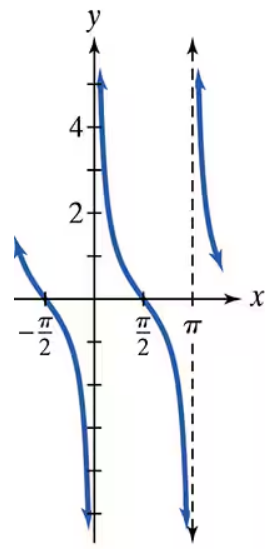
The graph of a tangent function is given. Select the equation for each graph from the following options: y = tan(x + π/2), y = tan(x + π), y = -tan x, y = −tan(x − π/2).

Verified step by step guidance
1
Identify the vertical asymptotes of the tangent graph. From the image, the asymptotes are at \(x = -\frac{\pi}{6}\) and \(x = \frac{5\pi}{6}\).
Recall that the standard tangent function \(y = \tan x\) has vertical asymptotes at \(x = \pm \frac{\pi}{2}\), and zeros at multiples of \(\pi\).
Compare the given asymptotes with the standard ones to find the horizontal shift. The distance between the asymptotes is \(\pi\), which matches the period of the tangent function.
Calculate the horizontal shift by comparing the asymptote \(x = -\frac{\pi}{6}\) to the standard \(x = -\frac{\pi}{2}\). The shift is \(\frac{\pi}{3}\) to the right.
Use the horizontal shift to write the equation in the form \(y = \tan(x + c)\) or \(y = -\tan(x + c)\), and check the sign by observing the slope of the graph between asymptotes to select the correct equation from the options.

Verified video answer for a similar problem:

This video solution was recommended by our tutors as helpful for the problem above.
Video duration:
2m
Was this helpful?

Key Concepts

Here are the essential concepts you must grasp in order to answer the question correctly.

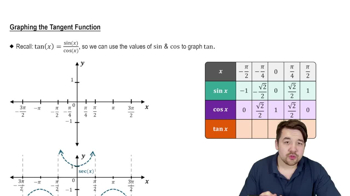
Tangent Function and Its Graph

The tangent function, tan(x), is periodic with period π and has vertical asymptotes where the function is undefined, at x = (2k+1)π/2 for integers k. Its graph passes through the origin (0,0) and repeats every π units, showing characteristic increasing curves between asymptotes.
Recommended video:
5:43
Introduction to Tangent Graph

Phase Shift in Trigonometric Functions

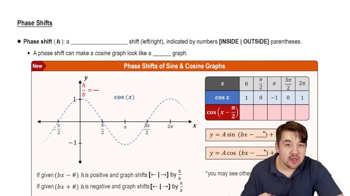
A phase shift in a trigonometric function like tan(x + c) shifts the graph horizontally by -c units. This affects the location of zeros and vertical asymptotes, moving them left or right along the x-axis, which helps identify the equation from the graph.
Recommended video:
6:31
Phase Shifts

Vertical Asymptotes and Their Role in Identifying Tangent Graphs

Vertical asymptotes occur where the tangent function is undefined, typically at x = (2k+1)π/2 for tan(x). By analyzing the positions of these asymptotes on the graph, one can determine the phase shift and sign changes, crucial for matching the graph to its equation.
Recommended video:
5:43
Introduction to Tangent Graph