Graph each function over a two-period interval. y = 1 - cot x
Verified step by step guidance
1
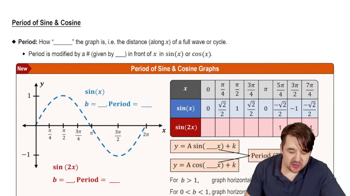
Identify the period of the function. Since the function is \(y = 1 - \cot x\), recall that the cotangent function \(\cot x\) has a period of \(\pi\). Therefore, a two-period interval for \(\cot x\) is \(2\pi\).
Determine the interval over which to graph the function. For \(\cot x\), a natural choice is from \$0$ to \(2\pi\) to cover two full periods.
Analyze the behavior of \(\cot x\) within one period. \(\cot x = \frac{\cos x}{\sin x}\) has vertical asymptotes where \(\sin x = 0\), which occur at \(x = 0, \pi, 2\pi\). Between these points, \(\cot x\) decreases from \(+\infty\) to \(-\infty\).
Apply the transformation to the function: \(y = 1 - \cot x\). This means you take the cotangent graph, reflect it vertically (because of the minus sign), and then shift it upward by 1 unit.
Sketch the graph over the interval \([0, 2\pi]\) by plotting key points and asymptotes at \(x = 0, \pi, 2\pi\), noting the vertical asymptotes and the shifted values of the function. This will give you the graph of \(y = 1 - \cot x\) over two periods.
Verified video answer for a similar problem:
This video solution was recommended by our tutors as helpful for the problem above
Play a video:
0 Comments
Key Concepts
Here are the essential concepts you must grasp in order to answer the question correctly.
Cotangent Function and Its Properties
The cotangent function, cot(x), is the reciprocal of the tangent function and is defined as cos(x)/sin(x). It has vertical asymptotes where sin(x) = 0, i.e., at integer multiples of π. Understanding its periodicity and behavior near asymptotes is essential for graphing.
The cotangent function has a fundamental period of π, meaning its values repeat every π units. Graphing over a two-period interval involves plotting the function from 0 to 2π or any interval of length 2π, capturing two full cycles of cot(x).
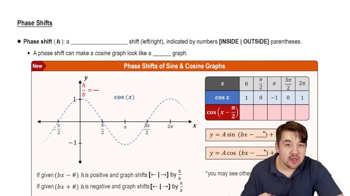
The function y = 1 - cot(x) involves a vertical shift of the cotangent graph by 1 unit upwards. This means every point on the cotangent curve is increased by 1, affecting the position of the graph but not its shape or period.

 Verified step by step guidance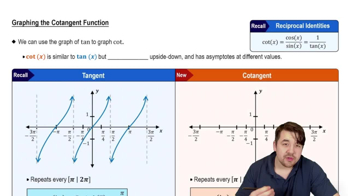
 5:37
5:37