Write each function in terms of its cofunction. Assume all angles involved are acute angles. See Example 2. sin 45°
Table of contents
- 0. Review of College Algebra4h 45m
- 1. Measuring Angles40m
- 2. Trigonometric Functions on Right Triangles2h 5m
- 3. Unit Circle1h 19m
- 4. Graphing Trigonometric Functions1h 19m
- 5. Inverse Trigonometric Functions and Basic Trigonometric Equations1h 41m
- 6. Trigonometric Identities and More Equations2h 34m
- 7. Non-Right Triangles1h 38m
- 8. Vectors2h 25m
- 9. Polar Equations2h 5m
- 10. Parametric Equations1h 6m
- 11. Graphing Complex Numbers1h 7m
3. Unit Circle
Trigonometric Functions on the Unit Circle
Problem 28
Textbook Question
In Exercises 28–29, find a cofunction with the same value as the given expression. sin 70°
Verified step by step guidance1
Recall the cofunction identity for sine and cosine: \(\sin(\theta) = \cos(90^\circ - \theta)\).
Identify the angle in the given expression: here, \(\theta = 70^\circ\).
Apply the cofunction identity by substituting \(\theta\) with \(70^\circ\): \(\sin 70^\circ = \cos(90^\circ - 70^\circ)\).
Simplify the expression inside the cosine: \(90^\circ - 70^\circ = 20^\circ\).
Write the final cofunction expression: \(\sin 70^\circ = \cos 20^\circ\).
Verified video answer for a similar problem:This video solution was recommended by our tutors as helpful for the problem above
Video duration:
1mPlay a video:
0 Comments
Key Concepts
Here are the essential concepts you must grasp in order to answer the question correctly.
Cofunction Identity
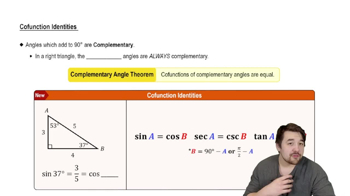
Cofunction identities relate trigonometric functions of complementary angles, meaning angles that add up to 90°. For sine and cosine, sin(θ) = cos(90° - θ). This identity allows us to find a cofunction with the same value by subtracting the given angle from 90°.
Recommended video:
Cofunction Identities
Complementary Angles
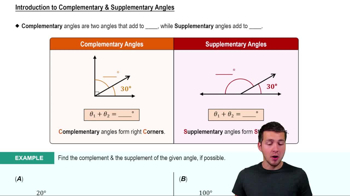
Complementary angles are two angles whose measures add up to 90°. Understanding this concept is essential because cofunction identities depend on the relationship between complementary angles, enabling the conversion between sine and cosine values.
Recommended video:
Intro to Complementary & Supplementary Angles
Evaluating Trigonometric Functions at Specific Angles
Evaluating trigonometric functions at specific angles, such as 70°, involves understanding angle measures and their corresponding function values. This skill helps in applying cofunction identities correctly to find equivalent expressions.
Recommended video:
Evaluate Composite Functions - Special Cases
Related Videos
Related Practice
Textbook Question
610
views