Give all six trigonometric function values for each angle θ . Rationalize denominators when applicable. sec θ = 5/4 , and θ is in quadrant IV
Verified step by step guidance
1
Recall that the secant function is the reciprocal of the cosine function, so from \(\sec \theta = \frac{5}{4}\), we can find \(\cos \theta\) by taking the reciprocal: \(\cos \theta = \frac{4}{5}\).
Since \(\theta\) is in quadrant IV, cosine is positive and sine is negative in this quadrant. Use the Pythagorean identity \(\sin^2 \theta + \cos^2 \theta = 1\) to find \(\sin \theta\). Substitute \(\cos \theta = \frac{4}{5}\) and solve for \(\sin \theta\).
Determine the sign of \(\sin \theta\) based on the quadrant. Since \(\theta\) is in quadrant IV, \(\sin \theta\) should be negative. So, take the negative root from the previous step.
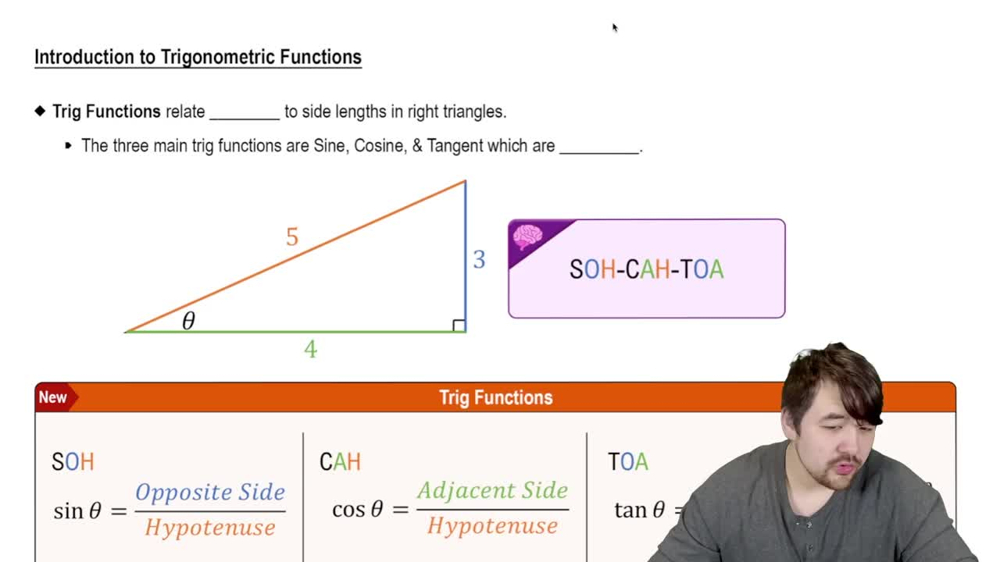
Find \(\tan \theta\) using the identity \(\tan \theta = \frac{\sin \theta}{\cos \theta}\). Substitute the values of \(\sin \theta\) and \(\cos \theta\) found earlier.
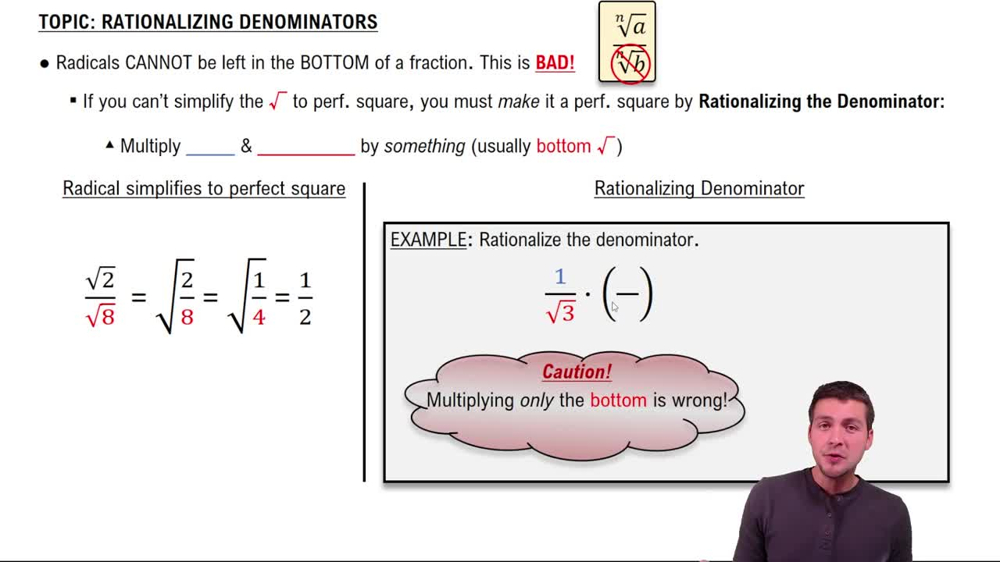
Calculate the remaining reciprocal functions: \(\csc \theta = \frac{1}{\sin \theta}\) and \(\cot \theta = \frac{1}{\tan \theta}\). Rationalize denominators if necessary.
Verified video answer for a similar problem:
This video solution was recommended by our tutors as helpful for the problem above
Video duration:
6m
Play a video:
0 Comments
Key Concepts
Here are the essential concepts you must grasp in order to answer the question correctly.
Reciprocal Trigonometric Functions
The six trigonometric functions include sine, cosine, tangent, cosecant, secant, and cotangent. Secant (sec θ) is the reciprocal of cosine (cos θ), meaning sec θ = 1/cos θ. Knowing sec θ allows you to find cos θ, which is essential for determining the other functions.
The sign of trigonometric functions depends on the quadrant of the angle. In quadrant IV, cosine and secant are positive, while sine and cosecant are negative. This knowledge helps assign correct signs to the calculated values of all six functions.
Pythagorean Identity and Rationalizing Denominators
The Pythagorean identity, sin²θ + cos²θ = 1, allows calculation of sine once cosine is known. Rationalizing denominators involves rewriting expressions to eliminate radicals or fractions in the denominator, ensuring answers are in standard simplified form.