Use the appropriate reciprocal identity to find each function value. Rationalize denominators when applicable. See Example 1. csc θ , given that sin θ = ―3/7
Verified step by step guidance
1
Recall the reciprocal identity relating cosecant and sine: \(\csc \theta = \frac{1}{\sin \theta}\).
Substitute the given value of \(\sin \theta = -\frac{3}{7}\) into the identity: \(\csc \theta = \frac{1}{-\frac{3}{7}}\).
Simplify the complex fraction by multiplying numerator and denominator appropriately: \(\csc \theta = \frac{1}{-\frac{3}{7}} = -\frac{7}{3}\).
Check if the denominator is rationalized; since \(-\frac{7}{3}\) has no radical in the denominator, no further rationalization is needed.
Conclude that \(\csc \theta\) is the simplified reciprocal of \(\sin \theta\) based on the steps above.
Verified video answer for a similar problem:
This video solution was recommended by our tutors as helpful for the problem above
Video duration:
1m
Play a video:
0 Comments
Key Concepts
Here are the essential concepts you must grasp in order to answer the question correctly.
Reciprocal Identities
Reciprocal identities relate trigonometric functions to each other by expressing one as the reciprocal of another. For example, cosecant (csc θ) is the reciprocal of sine (sin θ), so csc θ = 1/sin θ. This identity allows you to find csc θ directly when sin θ is known.
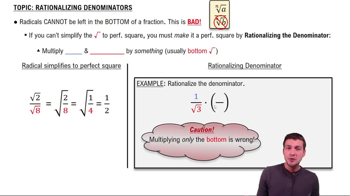
Rationalizing the denominator involves eliminating any radicals or fractions from the denominator of a fraction. This is done by multiplying numerator and denominator by a suitable expression to simplify the expression and make it easier to interpret or use in further calculations.
Evaluating Trigonometric Functions from Given Values
When given the value of one trigonometric function, you can find related functions using identities and algebraic manipulation. In this case, knowing sin θ allows you to find csc θ using the reciprocal identity, and you must consider the sign and domain of θ if needed.

 1:43 minutes
 Verified step by step guidance
 6:25
6:25