CONCEPT PREVIEW Determine whether each statement is possible or impossible. cos θ = 1.5
Table of contents
- 0. Review of College Algebra4h 45m
- 1. Measuring Angles40m
- 2. Trigonometric Functions on Right Triangles2h 5m
- 3. Unit Circle1h 19m
- 4. Graphing Trigonometric Functions1h 19m
- 5. Inverse Trigonometric Functions and Basic Trigonometric Equations1h 41m
- 6. Trigonometric Identities and More Equations2h 34m
- 7. Non-Right Triangles1h 38m
- 8. Vectors2h 25m
- 9. Polar Equations2h 5m
- 10. Parametric Equations1h 6m
- 11. Graphing Complex Numbers1h 7m
2. Trigonometric Functions on Right Triangles
Trigonometric Functions on Right Triangles
Problem 2.5.16
Textbook Question
Concept Check The two methods of expressing bearing can be interpreted using a rectangular coordinate system. Suppose that an observer for a radar station is located at the origin of a coordinate system. Find the bearing of an airplane located at each point. Express the bearing using both methods. (-3, -3)
Verified step by step guidance1
Identify the coordinates of the airplane relative to the radar station at the origin: \((-3, -3)\).
Calculate the angle \(\theta\) that the line from the origin to the point makes with the positive x-axis using the arctangent function: \(\theta = \arctan\left(\frac{y}{x}\right) = \arctan\left(\frac{-3}{-3}\right)\).
Determine the quadrant of the point \((-3, -3)\) to correctly adjust the angle \(\theta\) because arctangent alone only gives values between \(-90^\circ\) and \(90^\circ\). Since both \(x\) and \(y\) are negative, the point lies in the third quadrant, so add \(180^\circ\) to the angle obtained from arctangent to get the correct direction from the positive x-axis.
Express the bearing in the first method (the standard compass bearing) by measuring the angle clockwise from the north (positive y-axis). To do this, convert the angle from the positive x-axis to the angle from the positive y-axis by using the relationship: \(\text{bearing} = 90^\circ + \theta\) (adjusted for quadrant).
Express the bearing in the second method (the quadrant bearing) by stating the angle as degrees east or west of north or south. Since the point is in the southwest quadrant, the bearing will be expressed as an angle west of south, calculated by finding the acute angle between the line and the south direction.
Verified video answer for a similar problem:This video solution was recommended by our tutors as helpful for the problem above
Video duration:
3mPlay a video:
0 Comments
Key Concepts
Here are the essential concepts you must grasp in order to answer the question correctly.
Bearing and Its Methods
Bearing is a way to express direction relative to a reference point, usually north. The two common methods are the compass bearing, which measures angles clockwise from north, and the quadrant bearing, which expresses direction as an angle east or west of north or south. Understanding both methods is essential to convert coordinates into bearings.
Recommended video:
Quadratic Formula
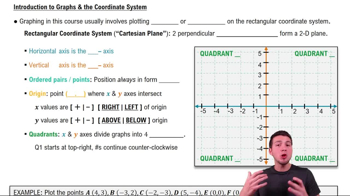
Rectangular Coordinate System and Position Vectors
A rectangular coordinate system uses x and y axes to locate points in a plane. The position of an object, like an airplane, can be represented as a vector from the origin (observer) to the point (x, y). This vector helps determine the direction and distance of the object relative to the observer.
Recommended video:
Introduction to Graphs & the Coordinate System
Calculating Angles Using Inverse Trigonometric Functions
To find the bearing from coordinates, the angle between the position vector and a reference axis is calculated using inverse tangent (arctan) or other inverse trig functions. Correctly interpreting the quadrant of the point is crucial to determine the accurate bearing angle.
Recommended video:
How to Use a Calculator for Trig Functions
Related Videos
Related Practice
Textbook Question
826
views