
Ch. 4 - Graphs of the Circular Functions
Lial - Trigonometry 12th Edition
Lial12th EditionTrigonometryISBN: 9780136552161Not the one you use?Change textbook
Chapter 5, Problem 17

Graph each function over a one-period interval.
y = 2 tan (¼ x)

Verified step by step guidance
1
Identify the basic function and its transformation: The given function is \(y = 2 \tan\left(\frac{1}{4}x\right)\). Here, the coefficient 2 is a vertical stretch, and the argument \(\frac{1}{4}x\) affects the period of the tangent function.
Recall the period of the basic tangent function \(\tan(x)\) is \(\pi\). For \(y = \tan(bx)\), the period is given by \(\frac{\pi}{|b|}\). In this case, \(b = \frac{1}{4}\), so the period is \(\frac{\pi}{\frac{1}{4}} = 4\pi\).
Determine the one-period interval for the function: Since the period is \(4\pi\), one period can be taken as \(x\) in \([0, 4\pi]\) or any interval of length \(4\pi\). For example, \([-2\pi, 2\pi]\) is also valid.
Identify the vertical asymptotes of the tangent function within one period. The tangent function has vertical asymptotes where its argument equals \(\frac{\pi}{2} + k\pi\), for integers \(k\). Solve \(\frac{1}{4}x = \frac{\pi}{2} + k\pi\) to find the asymptotes in terms of \(x\).
Plot key points: At \(x=0\), \(y=2 \tan(0) = 0\). At \(x\) values where \(\frac{1}{4}x = \frac{\pi}{4}\) or \(\frac{3\pi}{4}\), calculate \(y\) values to understand the shape. Use the vertical asymptotes to sketch the graph of \(y=2 \tan\left(\frac{1}{4}x\right)\) over one period.

Verified video answer for a similar problem:

This video solution was recommended by our tutors as helpful for the problem above.
Was this helpful?

Key Concepts

Here are the essential concepts you must grasp in order to answer the question correctly.

Period of the Tangent Function

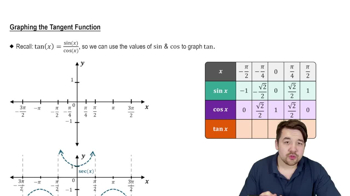
The standard period of the tangent function, tan(x), is π. When the function is transformed as tan(bx), the period changes to π divided by the absolute value of b. Understanding this helps determine the interval over which to graph one full cycle of y = 2 tan(¼ x).
Recommended video:
5:43
Introduction to Tangent Graph

Amplitude and Vertical Stretch

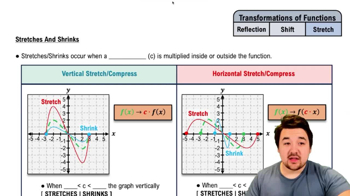
Although tangent functions do not have a maximum or minimum amplitude, the coefficient outside the function, here 2, vertically stretches the graph. This affects the steepness of the curve but does not change the period or asymptotes.
Recommended video:
6:02
Stretches and Shrinks of Functions

Vertical Asymptotes of Tangent

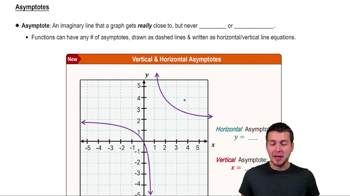
Tangent functions have vertical asymptotes where the cosine function equals zero, causing the function to approach infinity. For y = 2 tan(¼ x), these asymptotes occur at values of x where ¼ x equals (2k+1)π/2, which is crucial for accurately sketching the graph.
Recommended video:
4:42
Asymptotes