Write each function in terms of its cofunction. Assume all angles involved are acute angles. See Example 2.cos(θ + 20°)
Verified step by step guidance
1
Recall the cofunction identities for acute angles, which relate trigonometric functions of complementary angles: for example, \(\cos(\alpha) = \sin(90^\circ - \alpha)\) and \(\sin(\alpha) = \cos(90^\circ - \alpha)\).
Identify the function you want to rewrite in terms of its cofunction. Here, the function is \(\cos(\theta + 20^\circ)\).
Apply the cofunction identity for cosine: replace \(\cos(\alpha)\) with \(\sin(90^\circ - \alpha)\). In this case, \(\alpha = \theta + 20^\circ\).
Write the expression as \(\sin\left(90^\circ - (\theta + 20^\circ)\right)\), which simplifies the argument inside the sine function.
Simplify the angle inside the sine function to get \(\sin(90^\circ - \theta - 20^\circ)\), which further simplifies to \(\sin(70^\circ - \theta)\).
Verified video answer for a similar problem:
This video solution was recommended by our tutors as helpful for the problem above
Video duration:
2m
Play a video:
0 Comments
Key Concepts
Here are the essential concepts you must grasp in order to answer the question correctly.
Cofunction Identities
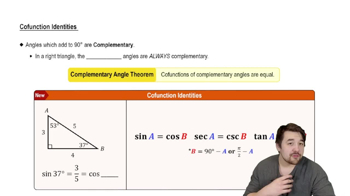
Cofunction identities relate pairs of trigonometric functions such that the function of an angle equals the cofunction of its complement. For example, sin(θ) = cos(90° - θ) and cos(θ) = sin(90° - θ). These identities are essential for rewriting functions in terms of their cofunctions.
The angle sum formula allows the evaluation of trigonometric functions of sums of angles, such as cos(θ + 20°) = cos θ cos 20° - sin θ sin 20°. Understanding this helps in breaking down complex angles into simpler components for manipulation or substitution.
Since all angles are acute (less than 90°), the complement of an angle (90° - θ) is also acute. This ensures the validity of cofunction identities and simplifies the process of expressing functions in terms of their cofunctions without ambiguity.

 2:31 minutes
 Verified step by step guidance
 6:30
6:30