In Exercises 11–20, use a polar coordinate system like the one shown for Exercises 1–10 to plot each point with the given polar coordinates. (3, 4π/3)
Table of contents
- 0. Review of College Algebra4h 45m
- 1. Measuring Angles40m
- 2. Trigonometric Functions on Right Triangles2h 5m
- 3. Unit Circle1h 19m
- 4. Graphing Trigonometric Functions1h 19m
- 5. Inverse Trigonometric Functions and Basic Trigonometric Equations1h 41m
- 6. Trigonometric Identities and More Equations2h 34m
- 7. Non-Right Triangles1h 38m
- 8. Vectors2h 25m
- 9. Polar Equations2h 5m
- 10. Parametric Equations1h 6m
- 11. Graphing Complex Numbers1h 7m
9. Polar Equations
Polar Coordinate System
Problem 19
Textbook Question
In Exercises 11–20, use a polar coordinate system like the one shown for Exercises 1–10 to plot each point with the given polar coordinates. (−2, − π/2)
Verified step by step guidance1
Recall that a point in polar coordinates is given as \((r, \theta)\), where \(r\) is the radius (distance from the origin) and \(\theta\) is the angle measured from the positive x-axis (polar axis).
Note that the given point is \((-2, -\frac{\pi}{2})\). The negative radius means we first consider the point at radius \$2$ but in the opposite direction of the angle \(-\frac{\pi}{2}\).
Since the angle \(-\frac{\pi}{2}\) corresponds to rotating \(\frac{\pi}{2}\) radians clockwise from the positive x-axis, identify this direction on the polar coordinate system (which points downward along the negative y-axis).
Because the radius is negative, move in the opposite direction of the angle \(-\frac{\pi}{2}\), which means moving \$2$ units in the direction of \(-\frac{\pi}{2} + \pi = \frac{\pi}{2}\) (upward along the positive y-axis).
Plot the point \$2$ units away from the origin along the positive y-axis, which corresponds to the adjusted angle \(\frac{\pi}{2}\), completing the plotting of the point with coordinates \((-2, -\frac{\pi}{2})\).
Verified video answer for a similar problem:This video solution was recommended by our tutors as helpful for the problem above
Video duration:
1mPlay a video:
0 Comments
Key Concepts
Here are the essential concepts you must grasp in order to answer the question correctly.
Polar Coordinates
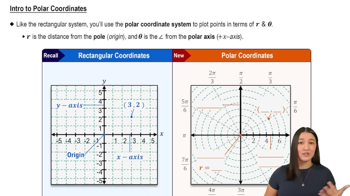
Polar coordinates represent points in a plane using a distance from the origin (radius r) and an angle θ measured from the positive x-axis. Each point is expressed as (r, θ), where r can be positive or negative, and θ is typically in radians or degrees.
Recommended video:
Intro to Polar Coordinates
Negative Radius in Polar Coordinates
A negative radius means the point is plotted in the direction opposite to the angle θ. For (−r, θ), you move |r| units along the line at angle θ + π (180 degrees), effectively reflecting the point across the origin.
Recommended video:
Intro to Polar Coordinates
Angle Measurement and Direction
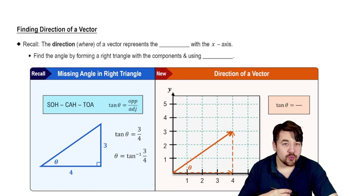
Angles in polar coordinates are measured counterclockwise from the positive x-axis. Negative angles indicate clockwise rotation. For example, an angle of −π/2 corresponds to a 90-degree rotation clockwise from the positive x-axis.
Recommended video:
Finding Direction of a Vector
Related Videos
Related Practice
Textbook Question
769
views