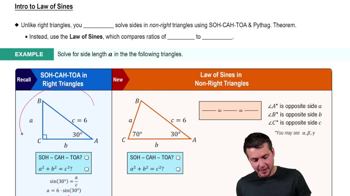
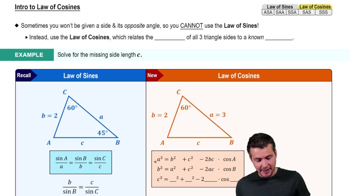
Step 1: Identify the given information from the triangle ABC. Typically, this includes the lengths of sides and measures of angles. If the image is not available, assume standard triangle properties or provide hypothetical values for illustration.
Step 2: Determine which trigonometric rules or theorems are applicable. For example, use the Law of Sines if you have two angles and one side (AAS or ASA) or the Law of Cosines if you have two sides and the included angle (SAS).
Step 3: Apply the chosen trigonometric rule. For the Law of Sines, use \( \frac{a}{\sin A} = \frac{b}{\sin B} = \frac{c}{\sin C} \). For the Law of Cosines, use \( c^2 = a^2 + b^2 - 2ab \cos C \).
Step 4: Solve for the unknowns. This could involve calculating missing side lengths or angle measures using the equations from Step 3.
Step 5: Verify your solution by checking that the sum of angles equals 180 degrees and that the side lengths satisfy the triangle inequality theorem.
Verified video answer for a similar problem:
This video solution was recommended by our tutors as helpful for the problem above
Play a video:
0 Comments
Key Concepts
Here are the essential concepts you must grasp in order to answer the question correctly.
Triangle Properties
Understanding the properties of triangles is essential for solving triangle ABC. This includes knowing that the sum of the interior angles in any triangle is always 180 degrees. Additionally, the relationships between the sides and angles, such as the Law of Sines and the Law of Cosines, are crucial for determining unknown values in the triangle.
The Law of Sines states that the ratio of the length of a side of a triangle to the sine of its opposite angle is constant for all three sides and angles. This law is particularly useful for solving triangles when you have two angles and one side (AAS or ASA) or two sides and a non-included angle (SSA). It allows for the calculation of unknown angles and sides effectively.
The Law of Cosines is a formula that relates the lengths of the sides of a triangle to the cosine of one of its angles. It is especially useful for solving triangles when you have two sides and the included angle (SAS) or all three sides (SSS). This law helps in finding unknown angles or sides when the conditions for the Law of Sines are not met.

 Verified step by step guidance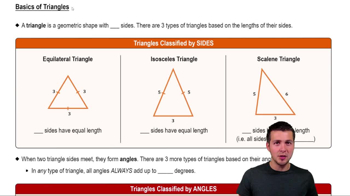
 4:42
4:42