In Exercises 81–86, solve each equation in the complex number system. Express solutions in polar and rectangular form. x⁶ − 1 = 0
Verified step by step guidance
1
Recognize that the equation \(x^{6} - 1 = 0\) can be rewritten as \(x^{6} = 1\). This means we are looking for the sixth roots of unity in the complex plane.
Express the number 1 in polar form. Since 1 is on the positive real axis, its polar form is \(1 = 1 \left( \cos 0 + i \sin 0 \right)\), or equivalently \(1 = 1 \operatorname{cis} 0\) where \(\operatorname{cis} \theta = \cos \theta + i \sin \theta\).
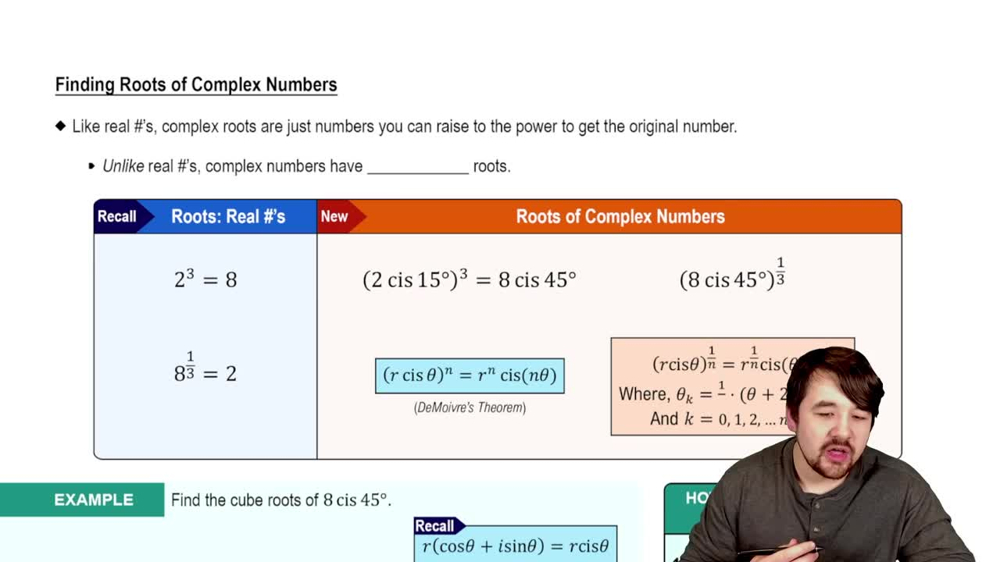
Use De Moivre's Theorem to find all sixth roots of unity. The general formula for the \(n\)th roots of a complex number \(r \operatorname{cis} \theta\) is \(r^{1/n} \operatorname{cis} \left( \frac{\theta + 2k\pi}{n} \right)\) for \(k = 0, 1, 2, ..., n-1\). Here, \(r=1\), \(\theta=0\), and \(n=6\).
Calculate each root by substituting \(k = 0, 1, 2, 3, 4, 5\) into the formula \(x_k = 1 \operatorname{cis} \left( \frac{2k\pi}{6} \right) = \cos \left( \frac{2k\pi}{6} \right) + i \sin \left( \frac{2k\pi}{6} \right)\) to get all six solutions in polar and rectangular form.
Write each solution explicitly in rectangular form as \(x_k = \cos \left( \frac{2k\pi}{6} \right) + i \sin \left( \frac{2k\pi}{6} \right)\) and in polar form as \(x_k = 1 \operatorname{cis} \left( \frac{2k\pi}{6} \right)\) for \(k = 0, 1, 2, 3, 4, 5\).
Verified video answer for a similar problem:
This video solution was recommended by our tutors as helpful for the problem above
Video duration:
10m
Play a video:
0 Comments
Key Concepts
Here are the essential concepts you must grasp in order to answer the question correctly.
Complex Roots of Unity
The equation x⁶ − 1 = 0 represents the 6th roots of unity, which are complex numbers that satisfy x⁶ = 1. These roots are evenly spaced points on the unit circle in the complex plane, each corresponding to an angle of 2πk/6 for k = 0, 1, ..., 5.
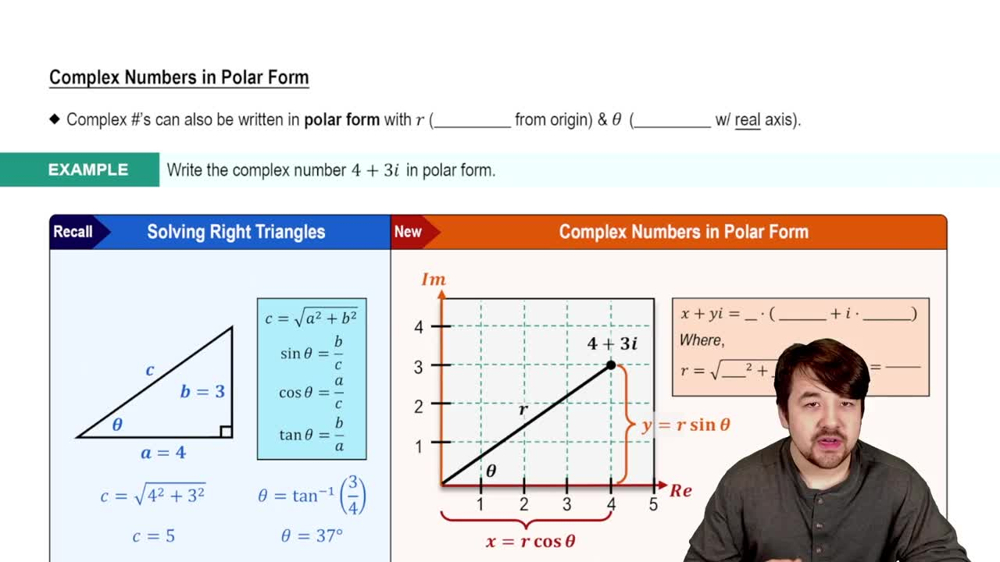
Polar form expresses a complex number as r(cos θ + i sin θ), where r is the magnitude and θ is the argument (angle). For roots of unity, r = 1, and θ corresponds to the angles dividing the circle evenly, making it easier to represent and multiply complex numbers.
Rectangular form represents complex numbers as a + bi, where a and b are real numbers. To convert from polar to rectangular form, use a = r cos θ and b = r sin θ. This conversion is essential to express solutions in both requested forms.