In Exercises 81–86, solve each equation in the complex number system. Express solutions in polar and rectangular form. x⁶ − 1 = 0
Ch. 5 - Complex Numbers, Polar Coordinates and Parametric Equations

All textbooks
Blitzer 3rd Edition
Ch. 5 - Complex Numbers, Polar Coordinates and Parametric Equations
Problem 81
Blitzer 3rd Edition
Ch. 5 - Complex Numbers, Polar Coordinates and Parametric Equations
Problem 81Chapter 5, Problem 81
In Exercises 81–82, find the rectangular coordinates of each pair of points. Then find the distance, in simplified radical form, between the points. (2, 2π/3) and (4, π/6)
Verified step by step guidance1
Identify that the given points are in polar coordinates, where each point is given as \((r, \theta)\) with \(r\) being the radius (distance from the origin) and \(\theta\) the angle in radians.
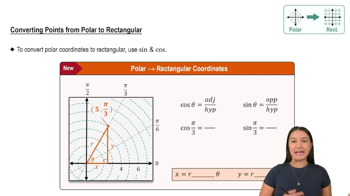
Convert each polar coordinate to rectangular coordinates using the formulas: \(x = r \cdot \cos(\theta)\) and \(y = r \cdot \sin(\theta)\).
For the first point \((2, \frac{2\pi}{3})\), calculate \(x_1 = 2 \cdot \cos\left(\frac{2\pi}{3}\right)\) and \(y_1 = 2 \cdot \sin\left(\frac{2\pi}{3}\right)\).
For the second point \((4, \frac{\pi}{6})\), calculate \(x_2 = 4 \cdot \cos\left(\frac{\pi}{6}\right)\) and \(y_2 = 4 \cdot \sin\left(\frac{\pi}{6}\right)\).
Use the distance formula between two points in rectangular coordinates: \(d = \sqrt{(x_2 - x_1)^2 + (y_2 - y_1)^2}\), and simplify the expression to get the distance in simplified radical form.

Verified video answer for a similar problem:
This video solution was recommended by our tutors as helpful for the problem above.
Video duration:
7mWas this helpful?
Key Concepts
Here are the essential concepts you must grasp in order to answer the question correctly.
Polar to Rectangular Coordinate Conversion
Polar coordinates (r, θ) represent points using a radius and an angle. To convert to rectangular coordinates (x, y), use x = r cos θ and y = r sin θ. This conversion is essential for comparing points or calculating distances in the Cartesian plane.
Recommended video:
Convert Points from Polar to Rectangular
Distance Formula in the Cartesian Plane
The distance between two points (x₁, y₁) and (x₂, y₂) in rectangular coordinates is given by the formula √[(x₂ - x₁)² + (y₂ - y₁)²]. This formula derives from the Pythagorean theorem and is used to find the straight-line distance between points.
Recommended video:
Quadratic Formula
Simplifying Radical Expressions
Simplifying radicals involves expressing square roots in their simplest form by factoring out perfect squares. This process makes the distance expression cleaner and easier to interpret, which is often required in final answers for trigonometry problems.
Recommended video:
Simplifying Trig Expressions
Related Practice
Textbook Question
754
views
Textbook Question
In calculus, it can be shown that e^(iθ) = cos θ + i sin θ. In Exercises 87–90, use this result to plot each complex number. e^(πi/4)
749
views
Textbook Question
In Exercises 77–80, convert to polar form and then perform the indicated operations. Express answers in polar and rectangular form.
(1 + i√3)(1 − i)) / 2√3 − 2i
484
views
Textbook Question
In Exercises 81–86, solve each equation in the complex number system. Express solutions in polar and rectangular form.
x³ − (1 + i√3) = 0
838
views
Textbook Question
In Exercises 79–80, convert each polar equation to a rectangular equation. Then determine the graph's slope and y-intercept.
r sin (θ − π/4) = 2
788
views
Textbook Question
In Exercises 81–86, solve each equation in the complex number system. Express solutions in polar and rectangular form.
x⁴ + 16i = 0
840
views