Ch 30: Inductance
Young & Freedman Calc - University Physics 14th Edition
Young & Freedman Calc14th EditionUniversity PhysicsISBN: 9780321973610Not the one you use?Change textbook
Chapter 30, Problem 1a

Two coils have mutual inductance M = 3.25 × 10⁻⁴ H. The current i1 in the first coil increases at a uniform rate of 830 A/s. What is the magnitude of the induced emf in the second coil? Is it constant?

Verified step by step guidance
1
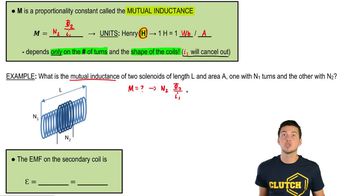
Understand the concept of mutual inductance: Mutual inductance is the property of two coils where a change in current in one coil induces an electromotive force (emf) in the other coil. The mutual inductance M is a measure of how effectively a change in current in one coil induces an emf in the other.
Recall the formula for induced emf due to mutual inductance: The induced emf (ε) in the second coil can be calculated using the formula: ε=Mdi1dt, where M is the mutual inductance and di1dt is the rate of change of current in the first coil.
Substitute the given values into the formula: You are given M = 3.25 × 10⁻⁴ H and di1dt = 830 A/s. Substitute these values into the formula to find the induced emf.
Calculate the magnitude of the induced emf: Perform the multiplication to find the magnitude of the induced emf in the second coil. The result will give you the magnitude of the induced emf.
Determine if the induced emf is constant: Since the rate of change of current di1dt is constant, the induced emf will also be constant over time.

Verified video answer for a similar problem:

This video solution was recommended by our tutors as helpful for the problem above.
Video duration:
3m
Was this helpful?

Key Concepts

Here are the essential concepts you must grasp in order to answer the question correctly.

Mutual Inductance

Mutual inductance is a measure of the ability of one coil to induce an electromotive force (emf) in another coil when the current in the first coil changes. It is denoted by M and is measured in henries (H). The mutual inductance depends on factors like the number of turns in the coils, their orientation, and the medium between them.
Recommended video:
Guided course
12:59
Mutual Induction

Faraday's Law of Electromagnetic Induction

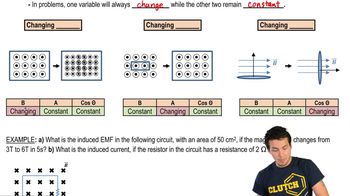
Faraday's Law states that a change in magnetic flux through a circuit induces an electromotive force (emf) in the circuit. The induced emf is proportional to the rate of change of the magnetic flux. In the context of mutual inductance, the induced emf in the second coil is given by the product of the mutual inductance and the rate of change of current in the first coil.
Recommended video:
Guided course
09:26
Faraday's Law

Rate of Change of Current

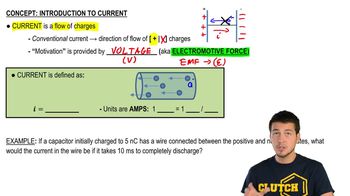
The rate of change of current refers to how quickly the current in a circuit is increasing or decreasing over time. It is expressed in amperes per second (A/s). In this problem, the current in the first coil changes at a uniform rate, which means the induced emf in the second coil will be constant, as it depends linearly on this rate of change.
Recommended video:
Guided course
05:38
Intro to Current