Ch. 12 - Adaptive Immunity
Norman-McKay- Microbiology: Basic and Clinical Principles 2nd Edition
Norman-McKay2nd EditionMicrobiology: Basic and Clinical PrinciplesISBN: 9780137661619Not the one you use?Change textbook
Chapter 12, Problem 14

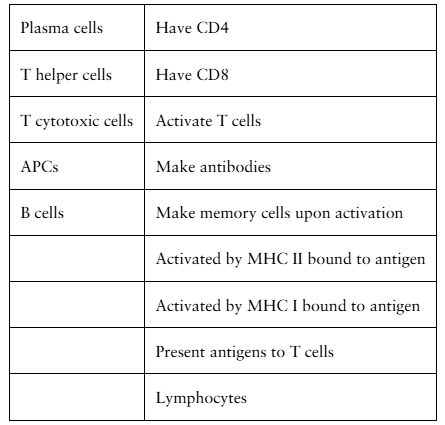
Match the cell to its stated feature. Some features will be assigned more than once.
Table listing immune cell types with their associated features and activation properties for matching.

Verified step by step guidance
1
Since the problem involves matching cells to their features, start by carefully examining the characteristics of each cell type presented in the image or description.
List the key features of each cell type, such as shape, presence of organelles (e.g., nucleus, mitochondria), cell wall composition, and any unique structures (e.g., flagella, pili).
Review the features provided in the problem and note which features are common to multiple cell types and which are unique.
Match each feature to the cell type(s) that exhibit it, remembering that some features may apply to more than one cell type.
Double-check your matches by comparing the known microbiological characteristics of each cell type with the features assigned, ensuring consistency and accuracy.

Verified video answer for a similar problem:

This video solution was recommended by our tutors as helpful for the problem above.
Video duration:
2m
Was this helpful?

Key Concepts

Here are the essential concepts you must grasp in order to answer the question correctly.

Cell Structure and Function

Understanding the basic components of different cell types, such as prokaryotic and eukaryotic cells, is essential. Each cell has unique structures like the nucleus, cell wall, or flagella that determine its functions and features.
Recommended video:
Guided course
05:42
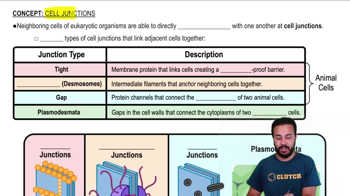
Cell Junctions

Microbial Cell Types

Recognizing various microbial cells, including bacteria, archaea, fungi, and protozoa, helps in matching cells to their features. Each group has distinct characteristics, such as cell wall composition or motility mechanisms.
Recommended video:
Guided course
07:24
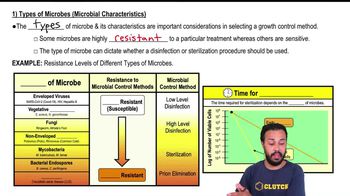
Types of Microbes (Microbial Characteristics)

Cellular Features and Adaptations

Features like shape, motility, metabolic capabilities, and environmental adaptations are key to identifying cells. Knowing how these features relate to survival and function aids in correctly matching cells to their descriptions.
Recommended video:
Guided course
05:47
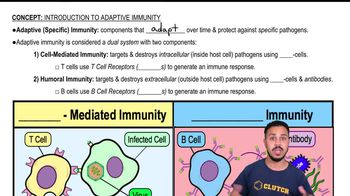
Introduction to Adaptive Immunity