Ch. 17 - Skin and Eye Infections
Norman-McKay- Microbiology: Basic and Clinical Principles 2nd Edition
Norman-McKay2nd EditionMicrobiology: Basic and Clinical PrinciplesISBN: 9780137661619Not the one you use?Change textbook
Chapter 17, Problem 12

Which best describes conjunctivitis (select ALL that apply)?
a. Itchy eyes
b. Scarred cornea
c. Red eyes
d. Inverted eyelashes
e. Scarred conjunctiva

Verified step by step guidance
1
Step 1: Understand that conjunctivitis, commonly known as pink eye, is an inflammation or infection of the conjunctiva, the transparent membrane covering the white part of the eye and the inner eyelids.
Step 2: Identify common symptoms of conjunctivitis, which typically include redness of the eyes due to inflammation and irritation, and itching caused by allergic or infectious agents.
Step 3: Recognize that scarred cornea and scarred conjunctiva are not typical features of conjunctivitis; these are usually associated with more severe or chronic eye conditions.
Step 4: Note that inverted eyelashes (entropion) are a separate condition where eyelashes turn inward and irritate the eye, not a characteristic of conjunctivitis.
Step 5: Based on these clarifications, select all options that describe symptoms or signs commonly associated with conjunctivitis, focusing on redness and itching.

Verified video answer for a similar problem:

This video solution was recommended by our tutors as helpful for the problem above.
Video duration:
1m
Was this helpful?

Key Concepts

Here are the essential concepts you must grasp in order to answer the question correctly.

Conjunctivitis Symptoms

Conjunctivitis, or pink eye, is an inflammation of the conjunctiva, often causing redness, itching, and discharge. Common symptoms include red eyes and itchy eyes, reflecting irritation and inflammation of the eye's surface.
Recommended video:
Guided course
05:09
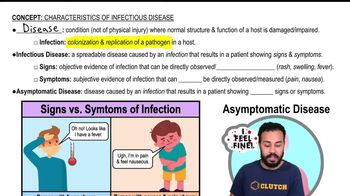
Intro to Characteristics of Infectious Disease

Corneal and Conjunctival Scarring

Scarring of the cornea or conjunctiva usually results from chronic or severe infections or trauma, not typical of acute conjunctivitis. While conjunctivitis can cause inflammation, scarring is more associated with other eye diseases or prolonged damage.

Eyelid Abnormalities

Inverted eyelashes, or entropion, is a condition where eyelashes turn inward, irritating the eye. This is a structural eyelid issue and not a symptom or direct consequence of conjunctivitis.
Recommended video:
Related Practice
Textbook Question

Select ALL the true statements about dermatophytes:

a. They are a group of bacteria that cause cutaneous infections.

b. They may be treated with antifungals without knowing the exact causative agent.

c. They are easily treated with antibiotics.

d. They are commonly acquired from the soil, environment, or animals.

e. They produce enzymes that digest keratin found in hair, nails, and skin.

1141
views
Textbook Question

Conjunctivitis is caused by the following agent types (select ALL that apply):

a. bacteria.

b. viruses.

c. protozoa.

d. fungi.

e. helminths.

1056
views
Textbook Question

Select the false statement about trachoma:

a. The causative agent is bacterial.

b. It is the leading cause of infectious blindness in the United States.

c. It is transmitted by unhygienic items, such as flies, fingers, and fomites.

d. Uncomplicated cases can be resolved with antibiotics.

e. Severe cases require surgery.

1091
views
Textbook Question

Acanthamoeba protozoa species are associated with:

a. keratitis.

b. conjunctivitis.

c. river blindness.

d. trachoma.

e. all of the above.

1528
views
Textbook Question

Select the false statement about cutaneous candidiasis:

a. The most common causative species is Candida albicans.

b. Candida albicans can be part of normal microbiota.

c. Usage of antibiotics can increase the chance of cutaneous candidiasis.

d. Changes in pH can permit overgrowth.

e. The causative agents are naturally found as mold filaments.

1139
views
Textbook Question

Your diabetic patient has a foot wound that has developed into serious necrosis and the recommended treatment has been sessions in the hyperbaric oxygen chamber. You are explaining to him what has contributed to this condition, including the causative agent, which is:

a. Bacillus anthracis.

b. Clostridium perfringens.

c. Corynebacteria diphtheriae.

d. Streptococcus pyogenes.

e. Pseudomonas aeroginosa.

1087
views