Ch. 7 - Fundamentals of Microbial Growth
Norman-McKay- Microbiology: Basic and Clinical Principles 2nd Edition
Norman-McKay2nd EditionMicrobiology: Basic and Clinical PrinciplesISBN: 9780137661619Not the one you use?Change textbook
Chapter 7, Problem 5

Choose the false statement about binary fission.
a. It generates genetically diverse daughter cells.
b. It is an asexual form of reproduction.
c. It is the most common way that prokaryotes divide.
d. It leads to exponential population growth.
e. If it occurs in a single plane, it could generate chains of bacteria.

Verified step by step guidance
1
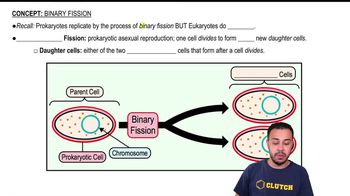
Step 1: Understand the process of binary fission. Binary fission is an asexual reproduction method used primarily by prokaryotes, where a single cell divides into two genetically identical daughter cells.
Step 2: Analyze option (a): "It generates genetically diverse daughter cells." Since binary fission produces clones, the daughter cells are genetically identical, not diverse. This suggests option (a) might be false.
Step 3: Review option (b): "It is an asexual form of reproduction." This is true because binary fission does not involve the exchange or recombination of genetic material.
Step 4: Consider option (c): "It is the most common way that prokaryotes divide." This is true, as binary fission is the primary division method for bacteria and archaea.
Step 5: Evaluate options (d) and (e): (d) states that binary fission leads to exponential population growth, which is correct because each division doubles the number of cells; (e) states that division in a single plane can form chains of bacteria, which is also true as seen in streptococci.

Verified video answer for a similar problem:

This video solution was recommended by our tutors as helpful for the problem above.
Video duration:
1m
Was this helpful?

Key Concepts

Here are the essential concepts you must grasp in order to answer the question correctly.

Binary Fission

Binary fission is an asexual reproduction process used by prokaryotes where a single cell divides into two genetically identical daughter cells. It involves DNA replication followed by cell division, ensuring the offspring are clones of the parent.
Recommended video:
Guided course
02:16
Binary Fission

Genetic Diversity in Prokaryotes

Unlike sexual reproduction, binary fission does not generate genetic diversity because it produces identical copies. Genetic variation in prokaryotes arises mainly through mutations or horizontal gene transfer, not through binary fission itself.
Recommended video:

Population Growth and Cell Arrangement

Binary fission leads to exponential population growth as each division doubles the number of cells. When division occurs in a single plane, cells remain attached, forming chains, which is common in some bacterial species like Streptococcus.
Recommended video:
Guided course
05:26
Cocci Bacterial Cell Arrangements