Ch. 4 - Introduction to Eukaryotic Cells
Norman-McKay- Microbiology: Basic and Clinical Principles 2nd Edition
Norman-McKay2nd EditionMicrobiology: Basic and Clinical PrinciplesISBN: 9780137661619Not the one you use?Change textbook
Chapter 4, Problem 9

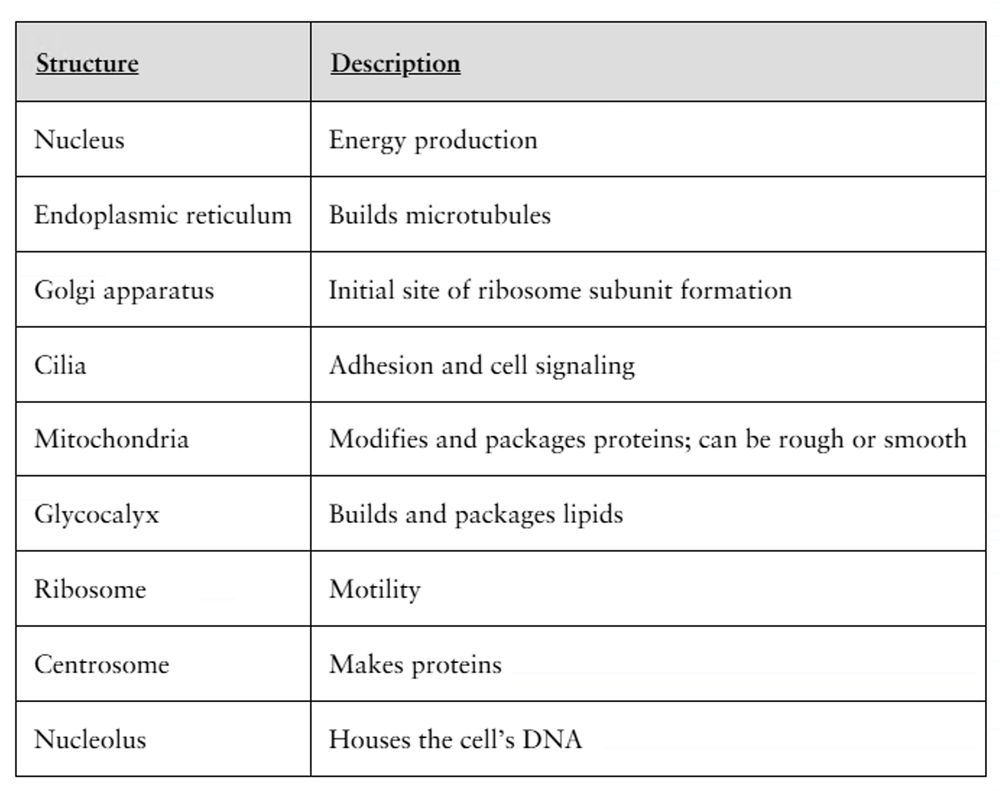
Match the organelle to the function
Table matching cell structures with their functions, listing organelles and their described roles in the cell.

Verified step by step guidance
1
Identify the organelles shown in the image or described in the problem. Common organelles include the nucleus, mitochondria, ribosomes, endoplasmic reticulum, Golgi apparatus, lysosomes, chloroplasts (in plant cells), and others.
Recall the primary function of each organelle. For example, the nucleus contains genetic material and controls cell activities; mitochondria generate ATP through cellular respiration; ribosomes synthesize proteins; the endoplasmic reticulum is involved in protein and lipid synthesis; the Golgi apparatus modifies and packages proteins; lysosomes digest cellular waste.
Create a list or table pairing each organelle with its known function based on your knowledge. This helps organize your thoughts and ensures you cover all options.
Compare the organelles in the image with your list and match each one to the function that best describes its role in the cell.
Double-check your matches by considering the unique features of each organelle and their functions to ensure accuracy before finalizing your answers.

Verified video answer for a similar problem:

This video solution was recommended by our tutors as helpful for the problem above.
Video duration:
2m
Was this helpful?

Key Concepts

Here are the essential concepts you must grasp in order to answer the question correctly.

Cell Organelles and Their Functions

Cell organelles are specialized structures within a cell that perform distinct functions essential for cellular life. Understanding the role of each organelle, such as the nucleus for genetic information storage or mitochondria for energy production, is crucial for matching organelles to their functions.
Recommended video:
Guided course
05:42
Cell Junctions

Structure-Function Relationship in Cells

The structure of an organelle is closely linked to its function. For example, the extensive membrane folds in mitochondria increase surface area for energy production, while the rough endoplasmic reticulum's ribosomes facilitate protein synthesis. Recognizing these relationships helps in identifying organelle functions.
Recommended video:
Guided course
05:42
Cell Junctions

Microscopy and Visualization of Organelles

Microscopy techniques allow visualization of organelles, often depicted in images or diagrams. Familiarity with how organelles appear under microscopes aids in correctly identifying them and associating their structure with their cellular roles.
Recommended video:
Guided course
03:46
Light Microscopy: Bright-Field Microscopes