Ch. 1 - Introduction to Microbiology
Norman-McKay- Microbiology: Basic and Clinical Principles 2nd Edition
Norman-McKay2nd EditionMicrobiology: Basic and Clinical PrinciplesISBN: 9780137661619Not the one you use?Change textbook
Chapter 1, Problem 4

Select the most accurate statement.
a. The Gram stain is a simple stain.
b. Bacterial endospores appear green from the acid-fast stain.
c. The acid-fast stain is used to detect bacteria that have a capsule.
d. Bacterial flagella can only be seen with electron microscopes.
e. The mordant in the Gram stain is iodine.

Verified step by step guidance
1
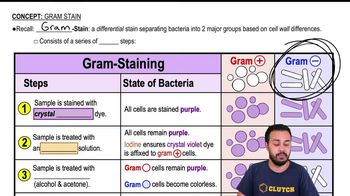
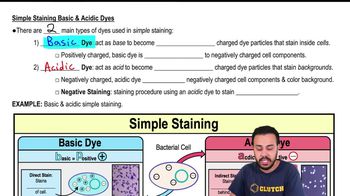
Step 1: Understand the purpose of each staining technique mentioned. The Gram stain differentiates bacteria based on cell wall properties, the acid-fast stain identifies bacteria with waxy cell walls, and simple stains generally color all cells uniformly.
Step 2: Evaluate option (a): The Gram stain is not a simple stain; it is a differential stain because it distinguishes between Gram-positive and Gram-negative bacteria using multiple reagents.
Step 3: Evaluate option (b): Bacterial endospores are typically stained green by the endospore stain (using malachite green), not by the acid-fast stain, which targets mycolic acid in cell walls and stains acid-fast bacteria red.
Step 4: Evaluate option (c): The acid-fast stain is used to detect bacteria with mycolic acid in their cell walls (like Mycobacterium), not bacteria with capsules. Capsule staining is a different technique.
Step 5: Evaluate options (d) and (e): Flagella are very thin and generally require special staining or electron microscopy to be seen, so (d) is accurate. The mordant in the Gram stain is iodine, which helps fix the crystal violet dye, so (e) is also accurate. Compare these two to select the most accurate statement.

Verified video answer for a similar problem:

This video solution was recommended by our tutors as helpful for the problem above.
Video duration:
2m
Was this helpful?

Key Concepts

Here are the essential concepts you must grasp in order to answer the question correctly.

Gram Stain and Mordant

The Gram stain is a differential staining technique that classifies bacteria as Gram-positive or Gram-negative based on cell wall properties. Iodine acts as the mordant, forming a complex with crystal violet dye to fix it inside the cell. This process is distinct from a simple stain, which uses only one dye without mordants.
Recommended video:

Acid-Fast Stain and Its Targets

The acid-fast stain is used to identify bacteria with waxy, mycolic acid-rich cell walls, such as Mycobacterium species. It does not stain capsules or endospores. Endospores require a different staining method (e.g., malachite green stain), and acid-fast bacteria appear red, not green.
Recommended video:
Guided course
05:30
Simple Staining Basic & Acidic Dyes

Microscopy of Bacterial Structures

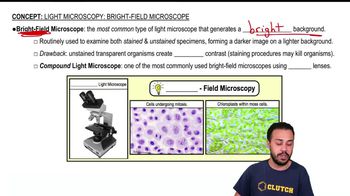
Bacterial flagella are too thin to be seen with light microscopes and typically require special staining or electron microscopy for visualization. Electron microscopes provide the high resolution needed to observe fine structures like flagella, which are essential for bacterial motility.
Recommended video:
Guided course
03:46
Light Microscopy: Bright-Field Microscopes
Related Practice
Textbook Question

Indicate the true statements and then correct the false statements so that they are true.

a. The Gram stain is a simple stain.

b. Simple stains reveal information about size, shape, and arrangement.

c. Bright field microscopy requires a stained sample.

d. Dark field microscopy requires a stained sample.

e. The acid-fast stain detects peptidoglycan in the cell walls of certain bacteria.

f. Gram-positive bacteria have a thin peptidoglycan layer in the cell wall.

917
views
Textbook Question

Indicate which form of electron microscopy is being described: SEM, TEM, or both.

a. Images the external surface of a specimen

b. Sample must be thinly sliced prior to viewing

c. Provides details about internal structures of the sample

d. Can be used to image viruses

e. Provides black-and-white images

f. Specimen is dead

1574
views
Textbook Question

Identify the following statements as observations or conclusions.

a. The solution turned red.

b. The bacterium is a rod shape.

c. The cell died due to lack of nutrients.

d. The bacterium is E. coli.

e. The cell is Gram-positive.

f. The bacterium is a pathogen.

g. There are small green structures present upon performing the endospore stain.

h. The solution remained clear after 10 hours of incubation.

i. Fermentation occurred.

j. Life comes from life.

1345
views
Textbook Question

Assume you are asked to view and draw all samples at a final magnification of 1000x. If the ocular lens is 10x, what objective lens should be in place as you draft your drawings?

1577
views
Textbook Question

Match the following people to their scientific/medical contribution:

Note: Choices may be used more than once or not at all.

1894
views
Textbook Question

Fill in the blanks: Bacteria are ___________________ cells in the domain ___________________. In contrast, the domain ___________________ includes unicellular and multicellular organisms that are made of ___________________ cells, or cells that have a nucleus and membrane-bound organelles.

1501
views