
Ch. 7 - Fundamentals of Microbial Growth
Norman-McKay- Microbiology: Basic and Clinical Principles 2nd Edition
Norman-McKay2nd EditionMicrobiology: Basic and Clinical PrinciplesISBN: 9780137661619Not the one you use?Change textbook
Chapter 7, Problem 11

Label each statement that follows as true or false, and correct the false statements so they are true:
a. Most pathogens would be considered mesophilic alkaliphiles.
b. Sterilization is a form of decontamination.
c. Disinfection is a form of decontamination.
d. High-level germicides achieve sterilization.
e. Ionizing radiation is a form of chemical microbial control.
f. Standard pasteurization is a way to sterilize milk.

Verified step by step guidance
1
Step 1: Understand the terms involved. 'Mesophilic' refers to organisms that grow best at moderate temperatures (20-45°C). 'Alkaliphiles' are organisms that thrive in alkaline (high pH) environments. Most pathogens are mesophiles but not alkaliphiles, so analyze the statement accordingly.
Step 2: Define 'sterilization' and 'decontamination'. Sterilization is the complete elimination of all forms of microbial life, including spores. Decontamination is a broader term that includes sterilization, disinfection, and cleaning to reduce microbial load to safe levels. Use this to evaluate statements about sterilization and decontamination.
Step 3: Clarify 'disinfection' as a form of decontamination. Disinfection reduces the number of pathogenic microorganisms but does not necessarily kill all spores. Confirm if disinfection fits under decontamination.
Step 4: Examine 'high-level germicides' and their capability. High-level germicides can kill all microorganisms except high numbers of bacterial spores. Determine if they achieve sterilization or not.
Step 5: Differentiate between 'ionizing radiation' and 'chemical microbial control'. Ionizing radiation is a physical method, not chemical. Also, understand that standard pasteurization reduces microbial load but does not sterilize milk. Use these clarifications to correct the false statements.

Verified video answer for a similar problem:

This video solution was recommended by our tutors as helpful for the problem above.
Video duration:
2m
Was this helpful?

Key Concepts

Here are the essential concepts you must grasp in order to answer the question correctly.

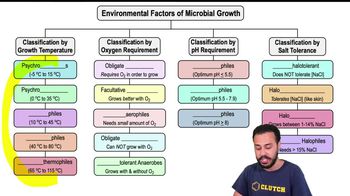
Microbial Growth Conditions: Mesophiles and Alkaliphiles

Mesophiles are microorganisms that grow best at moderate temperatures (20-45°C), while alkaliphiles thrive in alkaline environments (pH above 9). Most human pathogens are mesophiles but not alkaliphiles, as the human body maintains a near-neutral pH. Understanding these terms helps classify pathogens based on their preferred growth conditions.
Recommended video:
Guided course
07:21
Reviewing the Environmental Factors of Microbial Growth

Sterilization, Disinfection, and Decontamination

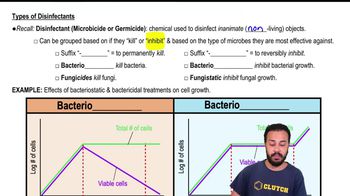
Sterilization is the complete elimination of all forms of microbial life, including spores. Disinfection reduces or eliminates pathogenic microbes but may not kill spores. Decontamination is a broader term encompassing any process that removes or reduces microbial contamination, including sterilization and disinfection.
Recommended video:
Guided course
05:21
Types of Disinfectants

Methods of Microbial Control: Physical vs Chemical

Microbial control methods include physical means like ionizing radiation (e.g., gamma rays) and heat, and chemical agents like germicides. Ionizing radiation is a physical method, not chemical. High-level germicides can achieve sterilization by killing spores, while standard pasteurization reduces microbial load but does not sterilize.
Recommended video:
Guided course
01:46
Physical Methods to Control Microbial Growth
Related Practice
Textbook Question

You are collecting a clinical sample for microbiological analysis. Which of the following is the most important thing you must do?

a. Follow aseptic protocols.

b. Refrigerate the samples immediately after collection.

c. Determine if the potential pathogen is an aerobe or strict anaerobe.

d. Determine if normal flora have been removed before the sample is collected.

935
views
Textbook Question

Which direct enumeration method differentiates living from nonliving cells?

a. Manual cell counts

b. Measuring dry weight of cells

c. Viable plate count

d. Measuring biochemical activity

e. Coulter counter

1038
views
Textbook Question

_____________ microbes use oxygen in metabolism, while _____________ do not.

1044
views
Textbook Question

You have a patient who is suffering from a Clostridioides difficile infection. Which of the following would most likely be recommended to decontaminate small heat-stable equipment used for the patient?

a. Autoclave all equipment at 121°C for 15 minutes.

b. Boil equipment for 3 minutes.

c. Place the equipment in a hot-air oven at 121°C for 15 minutes.

d. Treat all equipment with a detergent solution.

e. None of the above.

1141
views
Textbook Question

Match the term to the proper description(s). A term can have more than one description.

765
views
Textbook Question

Choose the false statement about turbidity as an enumeration method.

a. It is an indirect enumeration method.

b. It is performed using a spectrophotometer.

c. It must be done using a liquid culture.

d. It differentiates between live and dead cells.

e. It is a rapid enumeration method.

1301
views