Ch. 1 - Introduction to Microbiology
Norman-McKay- Microbiology: Basic and Clinical Principles 2nd Edition
Norman-McKay2nd EditionMicrobiology: Basic and Clinical PrinciplesISBN: 9780137661619Not the one you use?Change textbook
Chapter 1, Problem 16

Immersion oil improves resolution by:
a. Limiting light refraction.
b. Magnifying the specimen.
c. Improving specimen contrast.
d. Making light waves shorter.
e. Making light waves faster.

Verified step by step guidance
1
Understand that resolution in microscopy refers to the ability to distinguish two close points as separate entities, which depends on the wavelength of light and the numerical aperture of the lens system.
Recall that immersion oil is used between the objective lens and the cover slip to reduce the refraction (bending) of light as it passes from the specimen to the lens.
Recognize that immersion oil has a refractive index similar to glass, which minimizes light refraction and allows more light to enter the objective lens, improving resolution.
Eliminate options that do not relate to how immersion oil works: it does not magnify the specimen (b), improve contrast directly (c), change the wavelength of light (d), or change the speed of light in a way that affects resolution (e).
Conclude that the correct mechanism by which immersion oil improves resolution is by limiting light refraction, corresponding to option (a).

Verified video answer for a similar problem:

This video solution was recommended by our tutors as helpful for the problem above.
Video duration:
1m
Was this helpful?

Key Concepts

Here are the essential concepts you must grasp in order to answer the question correctly.

Light Refraction in Microscopy

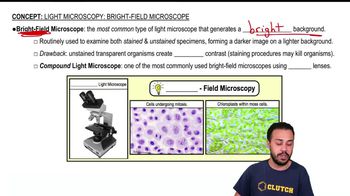
Refraction is the bending of light as it passes between materials with different refractive indices. In microscopy, minimizing refraction between the specimen, slide, and objective lens is crucial to maintain light path integrity and improve image clarity.
Recommended video:
Guided course
03:46
Light Microscopy: Bright-Field Microscopes

Role of Immersion Oil

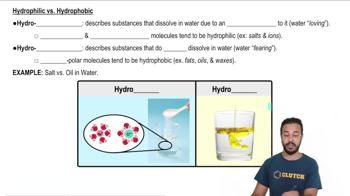
Immersion oil has a refractive index similar to glass, reducing light refraction between the slide and the objective lens. This allows more light to enter the lens, enhancing resolution and producing a clearer, more detailed image.
Recommended video:
Guided course
03:43
Hydrophilic vs. Hydrophobic

Resolution in Light Microscopy

Resolution is the ability to distinguish two close points as separate. It depends on the wavelength of light and the numerical aperture of the lens. Using immersion oil helps increase numerical aperture, thereby improving resolution.
Recommended video:
Guided course
03:46
Light Microscopy: Bright-Field Microscopes
Related Practice
Textbook Question

Which of the following is/are true regarding our normal microbiota? Select all that apply.

a. Our normal microbiota is easily disrupted by hygiene practices like hand washing.

b. Our normal microbiota can include pathogens.

c. Normal microbiota compete with pathogens.

d. Normal microbiota may colonize us before we are even born.

e. Normal microbiota changes over time.

f. The normal microbiota that we have as adults is the same as we had as children.

g. The normal microbiota of the gut is similar to that of the skin.

1880
views
Textbook Question

___________________ are dormant structures that certain bacteria can make. These structures can be seen using the structural stain called the ___________________.

1547
views
Textbook Question

List the following taxonomic groupings in order from general to specific.

Phylum, Kingdom, Genus, Family, Class, Domain, Species, Order

1459
views
Textbook Question

Classify the following as bright field, dark field, phase contrast, or differential interference contrast (DIC).

a. Sample must be stained or have its own coloration to be seen:

b. Specimen is illuminated with polarized light:

c. Generates a falsely three-dimensional image:

d. The simplest and most common form of light microscopy:

e. Generates a negative image using a hollow cone of light:

f. Generates a negative image in which light shifts are converted into visible changes in brightness and contrast:

1365
views
Textbook Question

Why is it clinically helpful to know the Gram property of an organism?

1733
views
Textbook Question

Over time, Koch’s disease postulates have been rephrased in a variety of ways, but they still reflect the same process outlined by Robert Koch. The following are reworded versions of Koch’s postulates. Based on the original postulates, put the following items in the correct order.

a. Use the purified agent to cause infection in a test animal.

b. Isolate an infectious agent from a diseased animal.

c. Grow the infectious agent as a pure culture in the lab.

d. From the test animal, re-isolate the infectious agent that was originally grown in pure culture.

1505
views