Ch. 11 - Innate Immunity
Norman-McKay- Microbiology: Basic and Clinical Principles 2nd Edition
Norman-McKay2nd EditionMicrobiology: Basic and Clinical PrinciplesISBN: 9780137661619Not the one you use?Change textbook
Chapter 11, Problem 9

Make a Venn diagram to compare and contrast innate and adaptive immunity.

Verified step by step guidance
1
Step 1: Identify the key characteristics of innate immunity. These include immediate response, non-specific defense mechanisms, physical and chemical barriers (like skin and mucous membranes), phagocytic cells (such as macrophages and neutrophils), and the absence of memory.
Step 2: Identify the key characteristics of adaptive immunity. These include a delayed response compared to innate immunity, specificity to particular pathogens, involvement of lymphocytes (B cells and T cells), the ability to remember previous encounters (immunological memory), and the production of antibodies.
Step 3: Draw two overlapping circles to represent the Venn diagram. Label one circle 'Innate Immunity' and the other 'Adaptive Immunity'.
Step 4: In the 'Innate Immunity' circle, list features unique to innate immunity such as immediate response, non-specificity, and physical barriers. In the 'Adaptive Immunity' circle, list features unique to adaptive immunity such as specificity, memory, and antibody production.
Step 5: In the overlapping area of the two circles, list the features shared by both types of immunity, such as their role in protecting the host from pathogens and involving cellular components of the immune system.

Verified video answer for a similar problem:

This video solution was recommended by our tutors as helpful for the problem above.
Video duration:
3m
Was this helpful?

Key Concepts

Here are the essential concepts you must grasp in order to answer the question correctly.

Innate Immunity

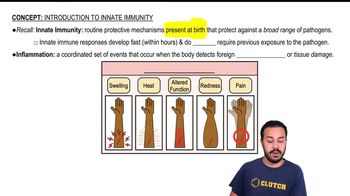
Innate immunity is the body's first line of defense against pathogens, providing a rapid, non-specific response. It includes physical barriers like skin, chemical defenses, and immune cells such as macrophages and neutrophils. This system does not have memory and responds similarly to repeated infections.
Recommended video:
Guided course
02:30
Introduction to Innate Immunity

Adaptive Immunity

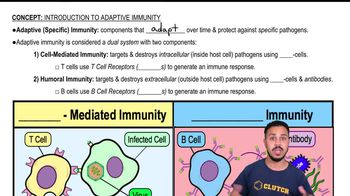
Adaptive immunity is a specific immune response that develops over time after exposure to a pathogen. It involves lymphocytes like B cells and T cells, which recognize specific antigens and create immunological memory for faster responses upon re-exposure. This system is slower to activate but highly specific.
Recommended video:
Guided course
05:47
Introduction to Adaptive Immunity

Comparison of Innate and Adaptive Immunity

Comparing innate and adaptive immunity highlights differences in response time, specificity, and memory. Innate immunity acts quickly and non-specifically without memory, while adaptive immunity is slower, antigen-specific, and capable of memory. Both systems work together to protect the body from infections.
Recommended video:
Guided course
02:30
Introduction to Innate Immunity