Ch. 20 - Urinary and Reproductive System Infections
Norman-McKay- Microbiology: Basic and Clinical Principles 2nd Edition
Norman-McKay2nd EditionMicrobiology: Basic and Clinical PrinciplesISBN: 9780137661619Not the one you use?Change textbook
Chapter 20, Problem 9

You see a corkscrew-like bacterial cell under dark field microscopy. If the sample came from __________, it is likely __________.
a. Genital lesions, leptospirosis
b. Urine, gonorrhea
c. Urine, syphilis
d. Genital lesions, syphilis
e. Vaginal discharge, chlamydia

Verified step by step guidance
1
Step 1: Identify the morphology described. A corkscrew-like bacterial cell is characteristic of spirochetes, which are spiral-shaped bacteria.
Step 2: Recall common diseases caused by spirochetes. Syphilis is caused by Treponema pallidum, a spirochete, and it typically presents with genital lesions.
Step 3: Consider the sample source. Syphilis is often diagnosed from lesions on the genital area rather than urine or vaginal discharge.
Step 4: Review the other options. Leptospirosis is also caused by a spirochete but is usually associated with exposure to contaminated water, not genital lesions. Gonorrhea and chlamydia are caused by different types of bacteria (Neisseria gonorrhoeae and Chlamydia trachomatis, respectively) and do not have a corkscrew shape.
Step 5: Match the correct pairing of sample source and disease based on morphology and clinical presentation.

Verified video answer for a similar problem:

This video solution was recommended by our tutors as helpful for the problem above.
Video duration:
2m
Was this helpful?

Key Concepts

Here are the essential concepts you must grasp in order to answer the question correctly.

Morphology of Spirochetes

Spirochetes are a group of bacteria characterized by their distinctive corkscrew or spiral shape. This morphology allows them to move in a twisting motion, which is important for their motility in viscous environments like mucus or tissue. Examples include Treponema pallidum (syphilis) and Leptospira species (leptospirosis).
Recommended video:
Guided course
02:44
Types of Bacterial Cell Morphology

Disease Associations of Spirochetes

Different spirochetes cause specific diseases linked to particular clinical presentations and sample sources. Treponema pallidum causes syphilis, often diagnosed from genital lesions, while Leptospira causes leptospirosis, typically associated with exposure to contaminated water or urine. Recognizing these associations helps identify the likely pathogen from clinical samples.
Recommended video:
Guided course
04:57
Communicable vs. Noncommunicable Diseases

Dark Field Microscopy in Microbiology

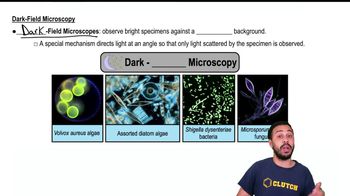
Dark field microscopy enhances the visualization of thin, transparent organisms like spirochetes by illuminating the specimen against a dark background. This technique is especially useful for detecting Treponema pallidum in genital lesion samples, as these bacteria are too thin to be seen with standard light microscopy.
Recommended video:
Guided course
01:52
Dark-Field Microscopy
Related Practice
Textbook Question

A patient you are assessing reports an increase in vaginal discharge that has a foul odor, but she does not report other symptoms. The patient has been in a monogamous relationship for 3 years. Which of the following would be the most useful for this patient? Select all that apply.

a. Evaluate her urine for increased white blood cells

b. Perform a Gram stain on the vaginal discharge

c. Run a pregnancy test

d. Test for an STI

e. Perform a whiff test

1191
views
Textbook Question

A male patient is complaining of frothy discharge and painful urination. After negative NAAT testing, you will most likely prescribe:

a. Penicillin

b. Tetracycline

c. A cephalosporin

d. Metronidazole

1125
views
Textbook Question

How do lactobacilli limit infections in the vagina? Select all that apply.

a. They competitively exclude potential pathogens

b. They make hydrogen peroxide

c. They ferment fructose to make lactic acid

d. They lower the vaginal pH, which limits pathogen growth

e. They increase the rate of vaginal mucus secretion

1210
views
Textbook Question

Patients can contract chlamydia more than once because:

a. It is so commonly antibiotic resistant

b. Long-term immunity is not established after infection

c. It hides in neurons and reactivates, lysing cells

d. It is sexually transmitted

e. All of the above apply

1288
views
Textbook Question

Indicate if the statement is true or false and then correct each false statement so that it is true:

a. Sexually transmitted infections always affect the reproductive tract

b. CAUTIs are usually classified as uncomplicated UTIs

c. Candida species are the leading cause of uncomplicated UTIs

d. Syphilis can be vertically transmitted from a mother to her fetus

e. Herpes simplex virus 2 can be transmitted to a partner without intercourse

1201
views
Textbook Question

Match the following terms to their definition. Some terms may be matched to more than one definition and some definitions may not be used.

<IMAGE>

1194
views