Ch. 12 - Adaptive Immunity
Norman-McKay- Microbiology: Basic and Clinical Principles 2nd Edition
Norman-McKay2nd EditionMicrobiology: Basic and Clinical PrinciplesISBN: 9780137661619Not the one you use?Change textbook
Chapter 12, Problem 7

Which of the following does not generate long-term immunological memory? Select all that apply.
a. Antivenom
b. Antitoxins
c. Vaccinations
d. Breast-feeding
e. Antigens

Verified step by step guidance
1
Step 1: Understand the concept of long-term immunological memory, which is the immune system's ability to remember a pathogen after initial exposure and respond more rapidly and effectively upon subsequent exposures. This memory is primarily generated by the activation of adaptive immunity, especially memory B and T cells.
Step 2: Analyze each option to determine if it involves the activation of adaptive immunity and the generation of memory cells. Vaccinations (option c) introduce antigens to stimulate this memory, so they do generate long-term immunological memory.
Step 3: Consider antivenoms (option a) and antitoxins (option b). These are preparations of antibodies given passively to neutralize toxins or venoms. Since they provide passive immunity, they do not stimulate the recipient's immune system to produce memory cells, so they do not generate long-term immunological memory.
Step 4: Evaluate breast-feeding (option d). Breast milk contains antibodies (mainly IgA) that provide passive immunity to the infant but do not induce the infant's immune system to develop memory cells, so it does not generate long-term immunological memory.
Step 5: Assess antigens (option e). Antigens themselves are substances that can trigger an immune response and are necessary for generating immunological memory. Therefore, antigens do contribute to long-term immunological memory.

Verified video answer for a similar problem:

This video solution was recommended by our tutors as helpful for the problem above.
Video duration:
5m
Was this helpful?

Key Concepts

Here are the essential concepts you must grasp in order to answer the question correctly.

Long-term Immunological Memory

Long-term immunological memory is the immune system's ability to remember a pathogen after initial exposure, enabling a faster and stronger response upon re-exposure. This memory is primarily generated by memory B and T cells formed during adaptive immune responses, often triggered by infections or vaccinations.
Recommended video:
Guided course
03:15
5 Protein-Related Terms

Passive vs. Active Immunity

Active immunity involves the body's own immune response producing memory cells after exposure to an antigen, leading to long-term protection. Passive immunity, such as receiving antivenoms, antitoxins, or antibodies through breast milk, provides immediate but temporary protection without generating memory cells.
Recommended video:
Guided course
04:18
Passive vs. Active Transport

Role of Vaccinations and Antigens

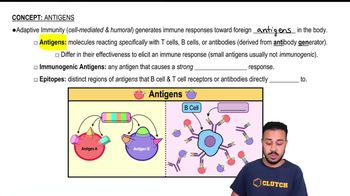
Vaccinations introduce antigens in a controlled way to stimulate active immunity and memory cell formation without causing disease. Antigens are substances that trigger immune responses, but by themselves do not generate memory unless presented in a way that activates adaptive immunity.
Recommended video: