Ch. 11 - Innate Immunity
Norman-McKay- Microbiology: Basic and Clinical Principles 2nd Edition
Norman-McKay2nd EditionMicrobiology: Basic and Clinical PrinciplesISBN: 9780137661619Not the one you use?Change textbook
Chapter 11, Problem 1

Classify each defense as either first-line, second-line cellular, or second-line molecular:
Inflammation
Neutrophils
Skin
Antimicrobial peptides
Lysozyme
Stomach acid
Eosinophils
Fever
Complement proteins
Mucus
Iron-binding proteins
Phagocytosis

Verified step by step guidance
1
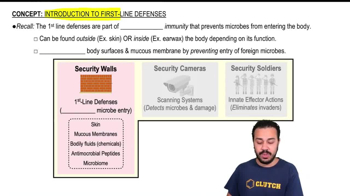
Step 1: Understand the classification of immune defenses. First-line defenses are physical and chemical barriers that prevent pathogen entry, such as skin and mucus. Second-line defenses are internal responses and can be divided into cellular (involving immune cells) and molecular (involving proteins and chemicals).
Step 2: Identify first-line defenses by looking for physical barriers and secretions that block or neutralize pathogens before they enter the body. Examples include skin, mucus, stomach acid, lysozyme, and antimicrobial peptides.
Step 3: Identify second-line cellular defenses by recognizing immune cells that respond to pathogens after they have breached the first line. Examples include neutrophils, eosinophils, and phagocytosis (which involves cells engulfing pathogens).
Step 4: Identify second-line molecular defenses by focusing on proteins and chemical responses that help eliminate pathogens internally. Examples include inflammation (a complex response involving molecules), fever (a systemic molecular response), complement proteins, and iron-binding proteins.
Step 5: Assign each defense to its category based on the above criteria: first-line (physical/chemical barriers), second-line cellular (immune cells), or second-line molecular (proteins and chemical responses). This systematic approach ensures accurate classification.

Verified video answer for a similar problem:

This video solution was recommended by our tutors as helpful for the problem above.
Video duration:
2m
Was this helpful?

Key Concepts

Here are the essential concepts you must grasp in order to answer the question correctly.

First-line Defenses

First-line defenses are the body's initial barriers that prevent pathogen entry. These include physical barriers like skin and mucus, and chemical barriers such as stomach acid and antimicrobial peptides. They act non-specifically to block or neutralize microbes before infection occurs.
Recommended video:
Guided course
01:51
Introduction to First-Line Defenses

Second-line Cellular Defenses

Second-line cellular defenses involve immune cells that respond after pathogens bypass first-line barriers. Key cells include neutrophils, eosinophils, and other phagocytes that engulf and destroy invaders. These cells also contribute to inflammation and coordinate further immune responses.
Recommended video:
Guided course
01:51
Introduction to First-Line Defenses

Second-line Molecular Defenses

Second-line molecular defenses consist of soluble proteins and molecules that target pathogens internally. Examples include complement proteins that lyse microbes, lysozyme that breaks bacterial cell walls, iron-binding proteins that limit microbial growth, and fever which enhances immune efficiency.
Recommended video:
Guided course
01:51
Introduction to First-Line Defenses