
Ch. 9 - Principles of Infectious Disease and Epidemiology
Norman-McKay- Microbiology: Basic and Clinical Principles 2nd Edition
Norman-McKay2nd EditionMicrobiology: Basic and Clinical PrinciplesISBN: 9780137661619Not the one you use?Change textbook
Chapter 9, Problem 6

Draft a Venn diagram to compare and contrast descriptive and analytical epidemiology.

Verified step by step guidance
1
Step 1: Define descriptive epidemiology by explaining that it involves characterizing the distribution of diseases within a population based on variables such as time, place, and person. It focuses on the 'who,' 'when,' and 'where' aspects of health events.
Step 2: Define analytical epidemiology by describing it as the branch that investigates the determinants or causes of health-related states or events. It focuses on the 'how' and 'why' by testing hypotheses about associations between exposures and outcomes.
Step 3: Identify similarities between descriptive and analytical epidemiology to place in the overlapping section of the Venn diagram. For example, both aim to understand health patterns and contribute to public health knowledge.
Step 4: List unique features of descriptive epidemiology in one circle, such as data collection methods (surveys, case reports), and its role in generating hypotheses.
Step 5: List unique features of analytical epidemiology in the other circle, such as study designs (cohort, case-control), and its role in testing hypotheses and establishing causal relationships.

Verified video answer for a similar problem:

This video solution was recommended by our tutors as helpful for the problem above.
Video duration:
2m
Was this helpful?

Key Concepts

Here are the essential concepts you must grasp in order to answer the question correctly.

Descriptive Epidemiology

Descriptive epidemiology involves characterizing the distribution of diseases by time, place, and person. It focuses on identifying patterns and trends in health events without investigating causes, often using data such as incidence and prevalence rates to generate hypotheses.
Recommended video:
Guided course
02:50
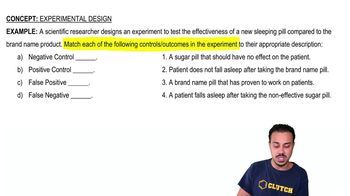
Experimental Design Example 1

Analytical Epidemiology

Analytical epidemiology aims to identify and evaluate the causes or risk factors of diseases by testing hypotheses. It uses study designs like cohort, case-control, and cross-sectional studies to examine associations between exposures and health outcomes.

Venn Diagram as a Comparative Tool

A Venn diagram visually represents similarities and differences between two concepts using overlapping circles. In epidemiology, it helps compare descriptive and analytical approaches by highlighting shared features and unique aspects, facilitating clearer understanding.
Recommended video:
Guided course
03:48
Microorganisms as Research Tools
Related Practice
Textbook Question

State what type of mortality rate is applicable.


Scenario 1: Out of 6,000 live births last week, 10 of the women died.

Type of mortality rate?

Scenario 2: 300 patients had disease X last year, 10 of whom died.

Type of mortality rate?

Scenario 3: Of the 120,000 live births in a particular community last year, 15 of the babies died before their first birthday.

Type of mortality rate?

Scenario 4: Out of 3,000 people in a given population, 100 died of pneumonia.

Type of mortality rate?

Calculated mortality rate (expressed per 100 in the population):

1152
views
Textbook Question

Diseases that the CDC collects information on through collaboration with state and local health authorities are called (NCLEX/HESI/TEAS)

a. Communicable diseases.

b. Reportable diseases.

c. Nationally notifiable diseases.

d. Investigative diseases.

e. Case report illnesses.

1348
views
Textbook Question

A(n) _______________________ groups the study populations by exposure versus nonexposure to a certain risk factor to see if either group develops the outcome in question.

a. Experimental study

b. Case report

c. Cross-sectional study

d. Correlation study

e. Observational study

1252
views
Textbook Question

Match the following:

765
views
Textbook Question

An epidemiological study design that is commonly used for determining the efficacy of a drug therapy is a(n)

a. Experimental study.

b. Case report.

c. Cross-sectional study.

d. Correlation study.

e. Observational study.

1238
views
Textbook Question

List three functions of public health.

1349
views