Ch. 1 - Introduction to Microbiology
Norman-McKay- Microbiology: Basic and Clinical Principles 2nd Edition
Norman-McKay2nd EditionMicrobiology: Basic and Clinical PrinciplesISBN: 9780137661619Not the one you use?Change textbook
Chapter 1, Problem 13

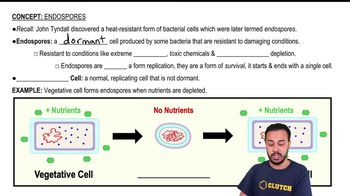
___________________ are dormant structures that certain bacteria can make. These structures can be seen using the structural stain called the ___________________.

Verified step by step guidance
1
Identify the type of dormant structures produced by certain bacteria. These structures are known for their ability to survive harsh environmental conditions by entering a dormant state.
Recall that these dormant structures are called 'endospores,' which are highly resistant to heat, desiccation, chemicals, and radiation.
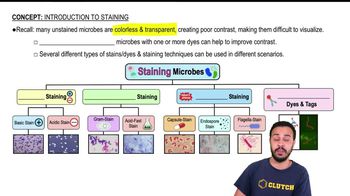
Understand that to visualize these endospores under a microscope, a special staining technique is required because endospores do not easily take up regular stains.
Recognize that the structural stain used specifically to detect endospores is the 'Schaeffer-Fulton stain,' which uses malachite green to stain the endospores and safranin as a counterstain for the vegetative cells.
Fill in the blanks with the terms: 'Endospores' for the dormant structures and 'Schaeffer-Fulton stain' for the structural stain used to see them.

Verified video answer for a similar problem:

This video solution was recommended by our tutors as helpful for the problem above.
Video duration:
1m
Was this helpful?

Key Concepts

Here are the essential concepts you must grasp in order to answer the question correctly.

Bacterial Endospores

Endospores are dormant, highly resistant structures formed by certain bacteria to survive harsh conditions like heat, desiccation, and chemicals. They allow bacteria to remain viable for long periods until favorable conditions return.
Recommended video:

Structural Staining Techniques

Structural stains are special staining methods used to highlight specific bacterial structures, such as capsules, flagella, or endospores, which are not easily seen with simple stains. These techniques help differentiate and identify bacterial components.
Recommended video:
Guided course
02:10
Introduction to Staining

Schaeffer-Fulton Endospore Stain

The Schaeffer-Fulton stain is a structural staining method specifically designed to visualize bacterial endospores. It uses malachite green to stain endospores and safranin as a counterstain for vegetative cells, making endospores clearly visible under a microscope.
Recommended video:
Related Practice
Textbook Question

Which of the following is/are true regarding our normal microbiota? Select all that apply.

a. Our normal microbiota is easily disrupted by hygiene practices like hand washing.

b. Our normal microbiota can include pathogens.

c. Normal microbiota compete with pathogens.

d. Normal microbiota may colonize us before we are even born.

e. Normal microbiota changes over time.

f. The normal microbiota that we have as adults is the same as we had as children.

g. The normal microbiota of the gut is similar to that of the skin.

1880
views
Textbook Question

Label and describe the function of each indicated part of the compound light microscope.

<IMAGE>

1644
views
Textbook Question

A(n) ___________________ is a genetic variant of the same species.

1695
views
Textbook Question

Classify the following as bright field, dark field, phase contrast, or differential interference contrast (DIC).

a. Sample must be stained or have its own coloration to be seen:

b. Specimen is illuminated with polarized light:

c. Generates a falsely three-dimensional image:

d. The simplest and most common form of light microscopy:

e. Generates a negative image using a hollow cone of light:

f. Generates a negative image in which light shifts are converted into visible changes in brightness and contrast:

1365
views
Textbook Question

How is an opportunistic pathogen different from a pathogen?

2118
views
Textbook Question

Immersion oil improves resolution by:

a. Limiting light refraction.

b. Magnifying the specimen.

c. Improving specimen contrast.

d. Making light waves shorter.

e. Making light waves faster.

1968
views