Ch. 11 - Innate Immunity
Norman-McKay- Microbiology: Basic and Clinical Principles 2nd Edition
Norman-McKay2nd EditionMicrobiology: Basic and Clinical PrinciplesISBN: 9780137661619Not the one you use?Change textbook
Chapter 11, Problem 13

Which would be expected to contribute to chronic inflammation? Select all that apply.
a. A reduced innate defense
b. Fever
c. Persistent tissue injury
d. Glucocorticosteroids
e. Antihistamines

Verified step by step guidance
1
Step 1: Understand the definition of chronic inflammation. Chronic inflammation is a prolonged inflammatory response that can last for months or years, often due to persistent injury, infection, or an inability to resolve the initial cause of inflammation.
Step 2: Analyze each option to determine if it contributes to chronic inflammation. For example, consider whether the factor causes ongoing tissue damage or impairs the resolution of inflammation.
Step 3: Evaluate option (a) 'A reduced innate defense.' A weakened innate immune system may allow infections or injuries to persist, potentially contributing to chronic inflammation.
Step 4: Evaluate option (c) 'Persistent tissue injury.' Continuous tissue damage is a classic cause of chronic inflammation because the body is constantly trying to repair the injury, maintaining the inflammatory response.
Step 5: Consider options (b) 'Fever,' (d) 'Glucocorticosteroids,' and (e) 'Antihistamines.' Fever is typically an acute response, glucocorticosteroids and antihistamines are anti-inflammatory agents that reduce inflammation rather than contribute to its chronicity.

Verified video answer for a similar problem:

This video solution was recommended by our tutors as helpful for the problem above.
Video duration:
3m
Was this helpful?

Key Concepts

Here are the essential concepts you must grasp in order to answer the question correctly.

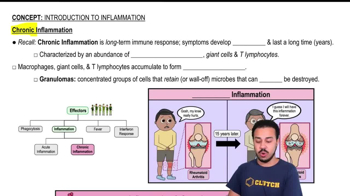
Chronic Inflammation

Chronic inflammation is a prolonged inflammatory response that can last weeks to years, often caused by persistent infections, ongoing tissue injury, or autoimmune reactions. It involves continuous activation of immune cells, leading to tissue damage and repair simultaneously.
Recommended video:
Guided course
03:09
Chronic Inflammation

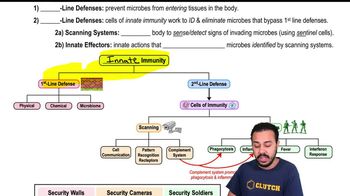
Innate Immune Defense

The innate immune system provides the first line of defense against pathogens through barriers, phagocytes, and inflammatory responses. A reduced innate defense can impair pathogen clearance, potentially allowing infections or injuries to persist and contribute to chronic inflammation.
Recommended video:
Guided course
06:42
Map of Lesson on Innate Immunity

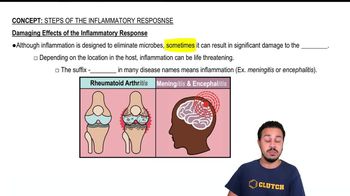
Anti-inflammatory Agents and Their Effects

Glucocorticosteroids and antihistamines are medications that reduce inflammation by suppressing immune responses or blocking histamine effects. While they help control acute inflammation, their use can influence the progression or resolution of chronic inflammation depending on timing and dosage.
Recommended video:
Guided course
02:10
Damaging Effects of the Inflammatory Response