Ch. 5 - Genetics
Norman-McKay- Microbiology: Basic and Clinical Principles 2nd Edition
Norman-McKay2nd EditionMicrobiology: Basic and Clinical PrinciplesISBN: 9780137661619Not the one you use?Change textbook
Chapter 5, Problem 15

Does the statement apply to DNA, RNA, or both?
a. Contains uracil
b. Usually double stranded
c. Found in the cytoplasm of eukaryotic cells
d. Contains thymine
e. Is made by transcription
f. Contains adenine
g. Made of nucleotides
h. Contains ribose
i. Contains phosphodiester bonds
j. Built in a 5' to 3' direction

Verified step by step guidance
1
Step 1: Understand the basic differences and similarities between DNA and RNA. DNA (deoxyribonucleic acid) and RNA (ribonucleic acid) are both nucleic acids made of nucleotides, but they differ in sugar type, nitrogenous bases, strand structure, and cellular location.
Step 2: For each statement, identify the key molecular feature it describes. For example, uracil is a nitrogenous base found only in RNA, while thymine is found only in DNA.
Step 3: Apply knowledge of structure and function: - 'Contains uracil' applies to RNA only. - 'Usually double stranded' applies to DNA only. - 'Found in the cytoplasm of eukaryotic cells' applies mainly to RNA, since DNA is mostly in the nucleus. - 'Contains thymine' applies to DNA only. - 'Is made by transcription' applies to RNA only. - 'Contains adenine' applies to both DNA and RNA. - 'Made of nucleotides' applies to both DNA and RNA. - 'Contains ribose' applies to RNA only (DNA contains deoxyribose). - 'Contains phosphodiester bonds' applies to both DNA and RNA. - 'Built in a 5' to 3' direction' applies to both DNA and RNA.
Step 4: Summarize each feature’s association with DNA, RNA, or both based on the above analysis.
Step 5: Review the molecular biology concepts of nucleic acid structure to reinforce understanding of why each statement applies to DNA, RNA, or both.

Verified video answer for a similar problem:

This video solution was recommended by our tutors as helpful for the problem above.
Video duration:
2m
Was this helpful?

Key Concepts

Here are the essential concepts you must grasp in order to answer the question correctly.

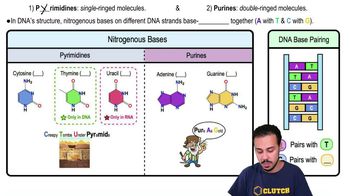
Differences in Nitrogenous Bases between DNA and RNA

DNA and RNA differ in their nitrogenous bases; DNA contains thymine while RNA contains uracil instead. Both have adenine, cytosine, and guanine, but the presence of uracil is unique to RNA, which helps distinguish the two molecules.
Recommended video:
Guided course
07:21
5 Nitrogenous Bases

Strand Structure and Cellular Location

DNA is typically double-stranded forming a double helix, whereas RNA is usually single-stranded. DNA is mainly found in the nucleus, while RNA is synthesized there but often functions in the cytoplasm, especially in eukaryotic cells.
Recommended video:
Guided course
02:32
Stages of Aerobic Cellular Respiration

Molecular Composition and Synthesis Direction

Both DNA and RNA are polymers made of nucleotides linked by phosphodiester bonds and built in the 5' to 3' direction. RNA contains ribose sugar, whereas DNA contains deoxyribose. RNA is synthesized from DNA by transcription.
Recommended video:
Guided course
03:20
The 3 Molecular Koch's Postulates