Ch. 10 - Host Microbe Interactions and Pathogenesis
Norman-McKay- Microbiology: Basic and Clinical Principles 2nd Edition
Norman-McKay2nd EditionMicrobiology: Basic and Clinical PrinciplesISBN: 9780137661619Not the one you use?Change textbook
Chapter 10, Problem 6

Select the false statement about normal microbiota.
a. They compete with pathogens.
b. They do not include potential pathogens.
c. They make vitamins for the host.
d. They train the immune system.
e. A disruption in their balance can lead to disease.

Verified step by step guidance
1
Step 1: Understand the concept of normal microbiota, which are the microorganisms that naturally reside on and within the human body without causing disease under normal conditions.
Step 2: Analyze each statement individually to determine its truthfulness based on microbiology principles:
Step 3: For statement (a), recall that normal microbiota compete with pathogens by occupying niches and resources, thus preventing pathogen colonization—this is true.
Step 4: For statement (b), consider that normal microbiota can include potential pathogens that are normally harmless but may cause disease if the balance is disrupted—this suggests the statement is false.
Step 5: For statements (c), (d), and (e), recognize that normal microbiota contribute to vitamin production, help train the immune system, and that disruption in their balance can lead to disease, so these are true.

Verified video answer for a similar problem:

This video solution was recommended by our tutors as helpful for the problem above.
Video duration:
4m
Was this helpful?

Key Concepts

Here are the essential concepts you must grasp in order to answer the question correctly.

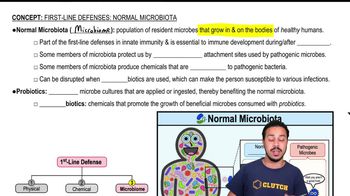
Normal Microbiota and Their Role

Normal microbiota are the community of microorganisms that naturally reside on and within the human body. They play essential roles such as competing with harmful pathogens for resources and space, thereby preventing infections. Understanding their beneficial functions is key to recognizing their importance in health.
Recommended video:
Guided course
03:43
Normal Microbiota

Potential Pathogens Within Normal Microbiota

Normal microbiota can include opportunistic pathogens—microbes that are usually harmless but can cause disease if the host’s defenses are compromised. This means that not all members of the normal microbiota are strictly non-pathogenic, highlighting the complexity of host-microbe interactions.
Recommended video:
Guided course
03:43
Normal Microbiota

Impact of Microbiota on Immune System and Health

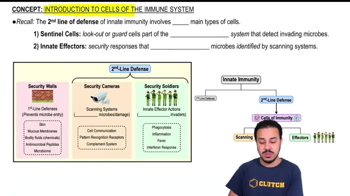
Normal microbiota contribute to the development and training of the host’s immune system, helping it distinguish between harmful and harmless agents. Disruptions in their balance, such as through antibiotics or illness, can lead to dysbiosis, increasing susceptibility to infections and other diseases.
Recommended video:
Guided course
03:21
Introduction to Cells of the Immune System
Related Practice
Textbook Question

Indicate the true statements and then correct the false statements so that they are true.

a. HIV is transmitted by a parenteral route.

b. Candida albicans is an opportunistic pathogen that can cause disease in an immune-competent host if the normal microbiota are disrupted.

c. Gram-positive bacteria may produce endotoxin.

d. Siderophores help pathogens obtain calcium.

e. Emerging pathogens tend to exhibit expanded tropism.

f. The more toxic a substance is, the higher its LD50.

g. Virulence is the ability of a microbe to cause disease.

h. Gram-negative bacteria may produce exotoxins.

31
views
Textbook Question

Pili, fimbriae, and sialic acid binding factors are examples of ________, which are virulence factors that allow pathogens to ________ host tissues––an essential early step in pathogenesis. In contrast, flagella, collagenases, and coagulases tend to act as ________, which help pathogens spread deeper into host tissues.

1157
views
Textbook Question

Define the class of each listed exotoxin as type I, II, or III:

a. Superantigen

b. Hemolysins

c. Staphylococcus aureus enterotoxins that cause food poisoning

d. AB toxin

e. Membrane-damaging toxins

f. Phospholipases

1635
views
Textbook Question

What is a reservoir, and why can C. difficile use a fomite as an effective environmental reservoir?

1434
views
Textbook Question

Toxigenic microbes produce _______. A high ID50 would suggest _______, and a low LD50 would suggest _______.

1270
views
Textbook Question

Which of the following is true regarding tropism?

a. It is the preference of a pathogen for a given tissue.

b. It is constant for a given microbe.

c. It limits a pathogen to infecting only one host.

d. It is determined by portal of entry.

e. It is independent of host factors.

846
views