Ch. 14 - Biomedical Applications: Vaccines, Diagnostics, Therapeutics, and Molecular Method
Norman-McKay- Microbiology: Basic and Clinical Principles 2nd Edition
Norman-McKay2nd EditionMicrobiology: Basic and Clinical PrinciplesISBN: 9780137661619Not the one you use?Change textbook
Chapter 14, Problem 4

How does an antibody neutralize a virus?
a. By preventing the virus from binding to a receptor protein on a host cell
b. By preventing the virus from injecting its nucleic acid into its host cell
c. By degrading the capsid
d. By inserting holes into the viral envelope
e. By preventing the virus from replicating while inside the host

Verified step by step guidance
1
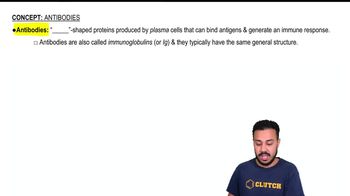
Step 1: Understand the role of antibodies in the immune response. Antibodies are proteins produced by B cells that specifically recognize and bind to antigens, such as viral surface proteins.
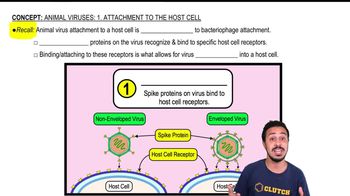
Step 2: Consider how viruses infect host cells. Viruses typically attach to specific receptor proteins on the surface of host cells to gain entry.
Step 3: Analyze the mechanism of neutralization. Neutralizing antibodies often block the virus's ability to bind to these receptor proteins, thereby preventing infection.
Step 4: Evaluate the other options. Antibodies do not usually degrade the viral capsid, insert holes into the viral envelope, or directly prevent viral replication inside the host cell; these are functions of other immune components or antiviral drugs.
Step 5: Conclude that the primary way antibodies neutralize viruses is by preventing the virus from binding to receptor proteins on host cells, effectively blocking the initial step of infection.

Verified video answer for a similar problem:

This video solution was recommended by our tutors as helpful for the problem above.
Video duration:
3m
Was this helpful?

Key Concepts

Here are the essential concepts you must grasp in order to answer the question correctly.

Antibody Neutralization Mechanism

Antibodies neutralize viruses primarily by binding to viral surface proteins, blocking the virus from attaching to host cell receptors. This prevents viral entry and infection, effectively stopping the virus before it can hijack the host cell machinery.
Recommended video:

Virus-Host Cell Interaction

Viruses infect host cells by recognizing and binding to specific receptor proteins on the cell surface. This interaction is crucial for viral entry, making receptor binding a key target for immune defense mechanisms like antibody neutralization.
Recommended video:
Guided course
03:12
Animal Viruses: 1. Attachment to the Host Cell

Viral Structure and Infection Process

Viruses consist of a nucleic acid core enclosed in a protein capsid, sometimes surrounded by a lipid envelope. Understanding the roles of these components helps explain how antibodies interfere with viral infection, mainly by targeting surface proteins rather than degrading capsids or disrupting envelopes.
Recommended video:
Guided course
05:12
Persistent Viral Infections
Related Practice
Textbook Question

What was the purpose of the practice of variolation?

1458
views
Textbook Question

Which of the following vaccines is most likely to be contraindicated for an immune compromised patient?

a. An mRNA vaccine

b. A whole inactivated vaccine

c. A toxoid vaccine

d. A conjugate vaccine

e. A live attenuated vaccine

1525
views
Textbook Question

If parents in the United States decline or delay vaccinations for their children because they fear the refuted claim of a link between vaccinations and autism, which of the following is a possible result?

a. A decrease in diagnosis of autism with a decrease of vaccinations

b. An increase in diagnosis of autism with an increase of vaccinations

c. An increase in the administration of subunit vaccines

d. A decrease in herd immunity

e. An increase in public demand for inactivated vaccines

1525
views
Textbook Question

What caused thousands of parents in the United States and the United Kingdom to stop vaccinating their children after 1998?

1418
views
Textbook Question

The human papillomavirus vaccine consists of surface proteins engineered from various HPV strains. How would you classify this vaccine?

a. Whole inactivated vaccine

b. Whole live attenuated vaccine

c. Recombinant subunit vaccine

d. mRNA vaccine

e. Vector vaccine

1680
views
Textbook Question

A direct ELISA test is utilized as a pregnancy test because it tests for:

a. Antibodies to the fetus in urine

b. Antibodies to a pregnancy hormone in urine

c. An antigen that recognizes a pregnancy hormone in urine

d. T cells that recognize a pregnancy hormone in urine

e. The presence of a pregnancy hormone in urine

2175
views