Ch. 7 - Fundamentals of Microbial Growth
Norman-McKay- Microbiology: Basic and Clinical Principles 2nd Edition
Norman-McKay2nd EditionMicrobiology: Basic and Clinical PrinciplesISBN: 9780137661619Not the one you use?Change textbook
Chapter 7, Problem 7

In a closed batch system, not all cells are expected to die, even as the death phase advances. Why?

Verified step by step guidance
1
Understand the phases of bacterial growth in a closed batch system: lag phase, exponential (log) phase, stationary phase, and death phase.
Recognize that during the death phase, the number of dying cells exceeds the number of new cells formed, but some cells survive due to various factors.
Consider that some cells enter a dormant or viable but non-culturable (VBNC) state, allowing them to resist harsh conditions and avoid death.
Acknowledge that genetic and physiological heterogeneity within the population leads to some cells having increased resistance to stress, such as nutrient depletion or toxic metabolites.
Conclude that these survival mechanisms explain why not all cells die during the death phase in a closed batch system.

Verified video answer for a similar problem:

This video solution was recommended by our tutors as helpful for the problem above.
Video duration:
2m
Was this helpful?

Key Concepts

Here are the essential concepts you must grasp in order to answer the question correctly.

Bacterial Growth Phases

Bacterial growth in a closed batch system follows distinct phases: lag, exponential, stationary, and death. During the death phase, the number of dying cells exceeds new cell formation, but some cells survive due to various factors, preventing total population collapse.
Recommended video:
Guided course
03:06
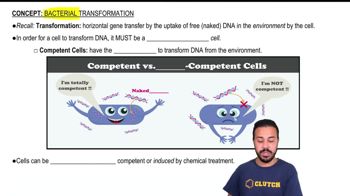
Bacterial Transformation

Persister Cells and Dormancy

Within a bacterial population, a subset of cells can enter a dormant state called persister cells. These cells are metabolically inactive and highly resistant to stress, allowing them to survive harsh conditions during the death phase.
Recommended video:
Guided course
05:12
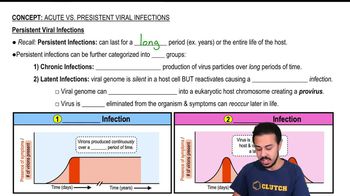
Persistent Viral Infections

Nutrient Limitation and Metabolic Adaptation

As nutrients deplete in a closed system, some cells adapt by slowing metabolism or utilizing alternative energy sources. This metabolic flexibility helps a fraction of the population survive longer, even as most cells die.
Recommended video:
Guided course
02:17
Introduction to Metabolism
Related Practice
Textbook Question

Match the term to the proper description(s). A term can have more than one description.

754
views
Textbook Question

You are collecting a clinical sample for microbiological analysis. Which of the following is the most important thing you must do?

a. Follow aseptic protocols.

b. Refrigerate the samples immediately after collection.

c. Determine if the potential pathogen is an aerobe or strict anaerobe.

d. Determine if normal flora have been removed before the sample is collected.

935
views
Textbook Question

Which direct enumeration method differentiates living from nonliving cells?

a. Manual cell counts

b. Measuring dry weight of cells

c. Viable plate count

d. Measuring biochemical activity

e. Coulter counter

1038
views
Textbook Question

Which of the following pathogens would hyperbaric oxygen therapy, a treatment that increases the level of dissolved oxygen in tissues, most likely ward off? Select all that apply.

a. Anaerobic thermophile

b. Anaerobic mesophile

c. Facultative anaerobic thermophile

d. Facultative anaerobic mesophile

e. Microaerophilic mesophile

916
views
Textbook Question

Match the term to the proper description(s). A term can have more than one description.

765
views
Textbook Question

Choose the false statement about binary fission.

a. It generates genetically diverse daughter cells.

b. It is an asexual form of reproduction.

c. It is the most common way that prokaryotes divide.

d. It leads to exponential population growth.

e. If it occurs in a single plane, it could generate chains of bacteria.

1638
views