Ch. 12 - Adaptive Immunity
Norman-McKay- Microbiology: Basic and Clinical Principles 2nd Edition
Norman-McKay2nd EditionMicrobiology: Basic and Clinical PrinciplesISBN: 9780137661619Not the one you use?Change textbook
Chapter 12, Problem 19

What is IgA protease, and what effect would it possibly have on host immune function?

Verified step by step guidance
1
Understand that IgA protease is an enzyme produced by certain bacteria that specifically cleaves Immunoglobulin A (IgA) antibodies.
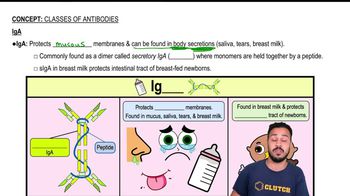
Recall that IgA antibodies are primarily found in mucosal areas such as the respiratory and gastrointestinal tracts, where they play a crucial role in immune defense by neutralizing pathogens and preventing their attachment to epithelial cells.
Recognize that by cleaving IgA, IgA protease disrupts this first line of immune defense, reducing the effectiveness of mucosal immunity.
Consider that the cleavage of IgA by IgA protease allows bacteria to evade immune detection and colonize mucosal surfaces more effectively, potentially leading to infection.
Summarize that the effect of IgA protease on host immune function is to impair mucosal immunity, facilitating bacterial survival and pathogenesis in the host.

Verified video answer for a similar problem:

This video solution was recommended by our tutors as helpful for the problem above.
Video duration:
2m
Was this helpful?

Key Concepts

Here are the essential concepts you must grasp in order to answer the question correctly.

IgA Protease

IgA protease is an enzyme produced by certain pathogenic bacteria that specifically cleaves Immunoglobulin A (IgA) antibodies. By targeting IgA, which is abundant in mucosal surfaces, these bacteria can evade immune detection and colonize host tissues more effectively.
Recommended video:
Guided course
02:59
Bacteria Avoid Antibodies by Producing IgA Proteases

Role of IgA in Immune Defense

IgA is a key antibody found in mucosal secretions like saliva, tears, and mucus, where it neutralizes pathogens and prevents their attachment to epithelial cells. It acts as the first line of defense in mucosal immunity, limiting infection at entry points.
Recommended video:

Impact of IgA Protease on Host Immunity

By degrading IgA, IgA protease impairs the host’s mucosal immune barrier, reducing antibody-mediated neutralization and clearance of pathogens. This enzymatic activity facilitates bacterial colonization and persistence, potentially leading to increased susceptibility to infections.
Recommended video:
Guided course
02:59
Bacteria Avoid Antibodies by Producing IgA Proteases