Ch. 9 - Principles of Infectious Disease and Epidemiology
Norman-McKay- Microbiology: Basic and Clinical Principles 2nd Edition
Norman-McKay2nd EditionMicrobiology: Basic and Clinical PrinciplesISBN: 9780137661619Not the one you use?Change textbook
Chapter 9, Problem 7

Diseases that the CDC collects information on through collaboration with state and local health authorities are called (NCLEX/HESI/TEAS)
a. Communicable diseases.
b. Reportable diseases.
c. Nationally notifiable diseases.
d. Investigative diseases.
e. Case report illnesses.

Verified step by step guidance
1
Understand the context: The CDC (Centers for Disease Control and Prevention) works with state and local health authorities to monitor certain diseases for public health purposes.
Recall definitions: Communicable diseases are those that can be transmitted from person to person, but not all communicable diseases are necessarily tracked by the CDC in this way.
Consider the term 'reportable diseases': These are diseases that healthcare providers must report to public health authorities, but the term is often used at the state level and may vary by jurisdiction.
Focus on 'nationally notifiable diseases': These are diseases that the CDC has designated for national tracking and requires states to report cases to the CDC to monitor trends and outbreaks across the country.
Match the correct term: Since the question asks for diseases the CDC collects information on through collaboration with state and local authorities, the best fit is 'nationally notifiable diseases.'

Verified video answer for a similar problem:

This video solution was recommended by our tutors as helpful for the problem above.
Video duration:
2m
Was this helpful?

Key Concepts

Here are the essential concepts you must grasp in order to answer the question correctly.

Reportable Diseases

Reportable diseases are specific illnesses that healthcare providers and laboratories are required by law to report to public health authorities. This reporting helps monitor and control disease outbreaks and protect public health.
Recommended video:
Guided course
04:57
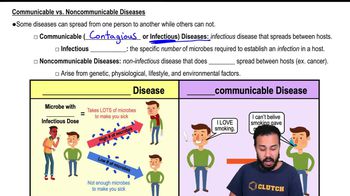
Communicable vs. Noncommunicable Diseases

Nationally Notifiable Diseases

Nationally notifiable diseases are a subset of reportable diseases that the CDC tracks through collaboration with state and local health departments. These diseases are important for national surveillance and public health response.
Recommended video:
Guided course
04:57
Communicable vs. Noncommunicable Diseases

Role of the CDC in Disease Surveillance

The Centers for Disease Control and Prevention (CDC) coordinates with state and local health authorities to collect data on certain diseases. This collaboration enables timely detection, investigation, and control of disease outbreaks across the country.
Recommended video:
Guided course
04:57
Communicable vs. Noncommunicable Diseases
Related Practice
Textbook Question

State what type of mortality rate is applicable.


Scenario 1: Out of 6,000 live births last week, 10 of the women died.

Type of mortality rate?

Scenario 2: 300 patients had disease X last year, 10 of whom died.

Type of mortality rate?

Scenario 3: Of the 120,000 live births in a particular community last year, 15 of the babies died before their first birthday.

Type of mortality rate?

Scenario 4: Out of 3,000 people in a given population, 100 died of pneumonia.

Type of mortality rate?

Calculated mortality rate (expressed per 100 in the population):

1152
views
Textbook Question

A(n) _______________________ groups the study populations by exposure versus nonexposure to a certain risk factor to see if either group develops the outcome in question.

a. Experimental study

b. Case report

c. Cross-sectional study

d. Correlation study

e. Observational study

1252
views
Textbook Question

Label the following modes of transmission as either direct or indirect. For all indirect transmissions, also specify which of the three categories of indirect transmission is involved.


Transmission of HIV across the placenta:

Transmission of a pathogen through drinking contaminated water:

Transmission of malaria by a mosquito to a human host:

Transmission of a pathogen through breast milk:

Transmission of rabies by a dog bite:

Transmission of a pathogen by touching a doorknob:

Transmission of a pathogen by a contaminated needle:

Transmission of a respiratory pathogen through respiratory droplets:

1373
views
Textbook Question

Draft a Venn diagram to compare and contrast descriptive and analytical epidemiology.

1278
views
Textbook Question

An epidemiological study design that is commonly used for determining the efficacy of a drug therapy is a(n)

a. Experimental study.

b. Case report.

c. Cross-sectional study.

d. Correlation study.

e. Observational study.

1238
views
Textbook Question

List three functions of public health.

1349
views