Ch. 12 - Adaptive Immunity
Norman-McKay- Microbiology: Basic and Clinical Principles 2nd Edition
Norman-McKay2nd EditionMicrobiology: Basic and Clinical PrinciplesISBN: 9780137661619Not the one you use?Change textbook
Chapter 12, Problem 11

Where do T cells undergo self-tolerance selection?

Verified step by step guidance
1
Understand that T cells develop in the thymus, an organ located in the upper chest, where they undergo processes to ensure they do not react against the body's own tissues.
Recognize that self-tolerance selection involves two main processes: positive selection and negative selection, both occurring in different regions of the thymus.
Identify that positive selection occurs in the thymic cortex, where T cells that can recognize self-MHC molecules are selected for survival.
Know that negative selection takes place primarily in the thymic medulla, where T cells that strongly bind to self-antigens presented by medullary thymic epithelial cells and dendritic cells are eliminated to prevent autoimmunity.
Conclude that the overall process of self-tolerance selection, especially the elimination of self-reactive T cells, occurs mainly in the thymus, involving both the cortex and medulla regions.

Verified video answer for a similar problem:

This video solution was recommended by our tutors as helpful for the problem above.
Video duration:
2m
Was this helpful?

Key Concepts

Here are the essential concepts you must grasp in order to answer the question correctly.

T Cell Development

T cells develop from hematopoietic stem cells in the bone marrow but mature primarily in the thymus. During this process, immature T cells undergo various stages of differentiation to become functional immune cells capable of recognizing antigens.
Recommended video:
Guided course
03:53
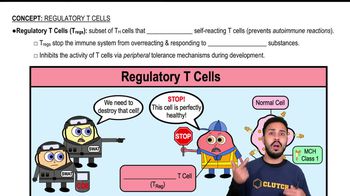
Regulatory T Cells

Self-Tolerance Selection

Self-tolerance selection is a critical process that eliminates or inactivates T cells that strongly recognize self-antigens, preventing autoimmune reactions. This selection ensures that T cells do not attack the body's own tissues.
Recommended video:
Guided course
11:54
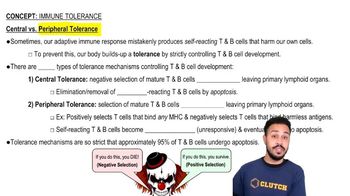
Central vs. Peripheral Tolerance

Thymic Selection (Positive and Negative Selection)

In the thymus, T cells undergo positive selection to ensure they can recognize self-MHC molecules, and negative selection to remove those that bind too strongly to self-antigens. This dual process establishes self-tolerance and functional T cell repertoires.
Recommended video:
Guided course
03:27
Selective Media