Ch. 11 - Innate Immunity
Norman-McKay- Microbiology: Basic and Clinical Principles 2nd Edition
Norman-McKay2nd EditionMicrobiology: Basic and Clinical PrinciplesISBN: 9780137661619Not the one you use?Change textbook
Chapter 11, Problem 2

Pick which statements are true, then correct all false statements, so they are also true.
a. Redness, pain, fever, and swelling characterize inflammation.
b. Granulocytes include monocytes and lymphocytes.
c. Pyrogens induce fever.
d. Adaptive and innate immune responses are completely independent from one another.
e. The innate immune responses occur faster than adaptive responses.
f. Monocytes are highly phagocytic cells.
g. Complement cascades share the same outcomes: opsonization, cytolysis, and fever.

Verified step by step guidance
1
Step 1: Evaluate statement (a): Redness, pain, fever, and swelling characterize inflammation. This is true because these are classic signs of the inflammatory response, which is part of the body's defense mechanism.
Step 2: Evaluate statement (b): Granulocytes include monocytes and lymphocytes. This is false. Granulocytes are a category of white blood cells characterized by granules in their cytoplasm and include neutrophils, eosinophils, and basophils. Monocytes and lymphocytes are agranulocytes, meaning they lack visible granules. Corrected statement: Granulocytes include neutrophils, eosinophils, and basophils.
Step 3: Evaluate statement (c): Pyrogens induce fever. This is true. Pyrogens are substances, often produced by bacteria or immune cells, that trigger the hypothalamus to raise body temperature, causing fever.
Step 4: Evaluate statement (d): Adaptive and innate immune responses are completely independent from one another. This is false. The innate and adaptive immune systems interact closely; the innate immune response often activates and shapes the adaptive immune response. Corrected statement: Adaptive and innate immune responses are interconnected and influence each other.
Step 5: Evaluate statement (e): The innate immune responses occur faster than adaptive responses. This is true. Innate immunity provides an immediate, nonspecific defense, while adaptive immunity takes longer to develop but is specific and has memory.
Step 6: Evaluate statement (f): Monocytes are highly phagocytic cells. This is true. Monocytes circulate in the blood and can differentiate into macrophages or dendritic cells, both of which are highly phagocytic.
Step 7: Evaluate statement (g): Complement cascades share the same outcomes: opsonization, cytolysis, and fever. This is false. Complement cascades result in opsonization and cytolysis, but they do not directly cause fever. Fever is typically induced by pyrogens, not complement activation. Corrected statement: Complement cascades result in opsonization, cytolysis, and inflammation, but not fever.

Verified video answer for a similar problem:

This video solution was recommended by our tutors as helpful for the problem above.
Video duration:
6m
Was this helpful?

Key Concepts

Here are the essential concepts you must grasp in order to answer the question correctly.

Inflammation and Its Characteristics

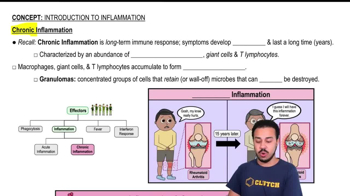
Inflammation is the body's immediate response to injury or infection, marked by redness, pain, heat (not always fever), swelling, and loss of function. These signs result from increased blood flow and immune cell activity at the affected site to eliminate pathogens and promote healing.
Recommended video:
Guided course
03:09
Chronic Inflammation

Types and Functions of White Blood Cells

White blood cells include granulocytes (neutrophils, eosinophils, basophils) and agranulocytes (monocytes, lymphocytes). Granulocytes contain granules and are involved in innate immunity, while monocytes and lymphocytes play roles in phagocytosis and adaptive immunity, respectively.
Recommended video:
Guided course
05:42
Cell Junctions

Innate vs. Adaptive Immune Responses and Pyrogens

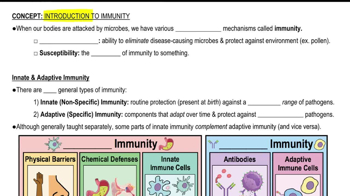
Innate immunity provides a rapid, non-specific defense, while adaptive immunity is slower but specific and has memory. Pyrogens are substances that trigger fever by acting on the hypothalamus, often released during innate immune responses to help fight infection.
Recommended video:
Guided course
05:52
Innate vs. Adaptive Immunity