Ch. 13 - Immune System Disorders
Norman-McKay- Microbiology: Basic and Clinical Principles 2nd Edition
Norman-McKay2nd EditionMicrobiology: Basic and Clinical PrinciplesISBN: 9780137661619Not the one you use?Change textbook
Chapter 13, Problem 6

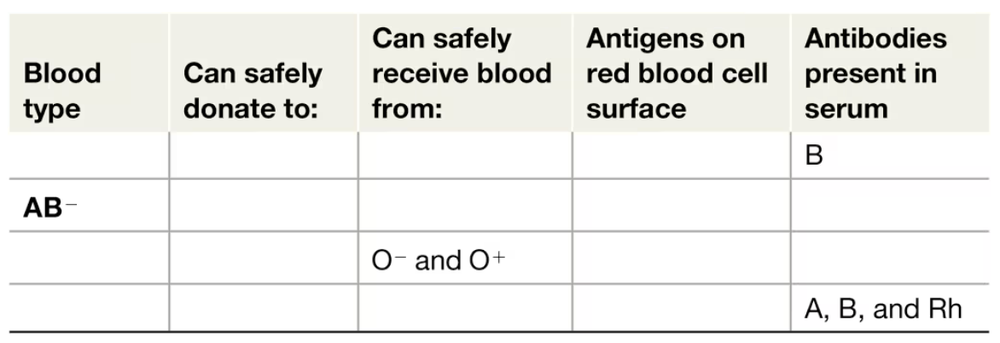
Fill in the table.
Partial table showing blood type AB negative with safe blood donors O negative and O positive, and antibodies B, A, B, and Rh present.

Verified step by step guidance
1
Since the problem asks to fill in a table related to microbiology, first identify what specific data or parameters the table requires (e.g., bacterial growth phases, enzyme activity, microbial counts, etc.).
Review the information provided in the image or accompanying text to understand the variables or categories that need to be filled in the table.
Determine the relationships or formulas that connect the known data to the unknown values in the table. For example, if the table involves microbial growth, recall the formula for exponential growth: \(N_t = N_0 \times 2^{(t/\text{generation time})}\).
Use the given data and apply the relevant formulas or concepts step-by-step to calculate or deduce the missing values for each row or column in the table.
Double-check each entry for consistency and accuracy, ensuring that units and biological interpretations align with microbiological principles.

Verified video answer for a similar problem:

This video solution was recommended by our tutors as helpful for the problem above.
Video duration:
3m
Was this helpful?

Key Concepts

Here are the essential concepts you must grasp in order to answer the question correctly.

Microbial Classification and Taxonomy

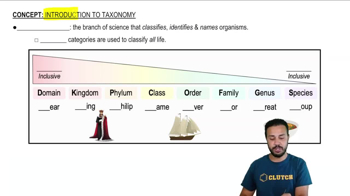
Understanding how microorganisms are classified based on characteristics such as shape, staining properties, and genetic makeup is essential. Taxonomy helps organize microbes into groups like bacteria, archaea, fungi, and viruses, which is crucial for filling in identification tables.
Recommended video:
Guided course
02:19
Introduction to Taxonomy

Microscopic Morphology of Microorganisms

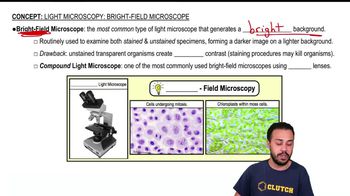
Knowledge of microbial shapes (cocci, bacilli, spirilla), arrangements (chains, clusters), and structural features (flagella, spores) is important for identifying and categorizing microbes in a table format.
Recommended video:
Guided course
03:46
Light Microscopy: Bright-Field Microscopes

Staining Techniques and Their Diagnostic Use

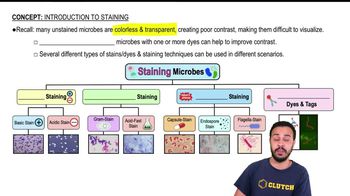
Staining methods like Gram staining differentiate bacteria by cell wall properties, aiding in classification. Recognizing staining results is key to completing tables that require information on microbial characteristics.
Recommended video:
Guided course
02:10
Introduction to Staining
Related Practice
Textbook Question

List the applicable hypersensitivities (type I, II, III, IV) as they relate to the description. Note, more than one type of hypersensitivity may be listed for a given description.

IgG antibodies can mediate type _________________hypersensitivities.

T cells mediate type _________________ hypersensitivities.

Type _________________ hypersensitivities may be generated in response to pharmaceutical drugs.

Type _________________ hypersensitivities may be associated with autoimmunity.

Type _________________ hypersensitivities require a sensitizing exposure.

IgE antibodies can mediate type _________________hypersensitivities.

1505
views
Textbook Question

Which patient would be the most likely to benefit from desensitization immunotherapy?

a. A person suffering from serum sickness

b. A person at risk for HDN during pregnancy

c. A person with an allergy to pollen

d. A transplant patient

e. An asthmatic patient

1111
views
Textbook Question

Which of the following is the most suggestive of an anaphylactic reaction? (NCLEX/HESI/TEAS)

a. Sudden fever

b. A localized rash

c. Nasal congestion

d. Hemorrhage

e. Respiratory distress

1580
views
Textbook Question

Which of the following would be recommended as a means to diagnose a type I sensitivity? Select all that apply.

a. Skin prick test

b. IgG titers

c. IgM titers

d. IgE titers

e. Histamine levels

1407
views
Textbook Question

Indicate the true statements, and then reword the false statements so they are true.

a. Immunodeficiencies are associated with a decreased cancer risk

b. Type I reactions are mediated by IgG antibodies

c. Autoimmune disorders are not caused by type I hypersensitivities

d. Systemic lupus is mainly mediated by a type III hypersensitivity

e. A person with type 0- blood is called a universal donor

f. Immunotherapies are useful to reduce type II reactions

1422
views
Textbook Question

Which scenario presents the greatest risk for HDN developing?

a. O− mother with O+ fetus

b. A+ mother with O+ fetus

c. B−mother with AB− fetus

d. A−mother with O−fetus

e. AB+ mother with AB−fetus

1427
views