Codons are ___________ nucleotides long and are in ___________, which is transcribed from DNA. During ___________, tRNAs serve as adapter molecules to bring ___________ to the ribosome to build a protein. Once the ribosome reaches a(n) ___________ on the mRNA, translation ends.
Ch. 5 - Genetics

Norman-McKay2nd EditionMicrobiology: Basic and Clinical PrinciplesISBN: 9780137661619Not the one you use?Change textbook
Chapter 5, Problem 9
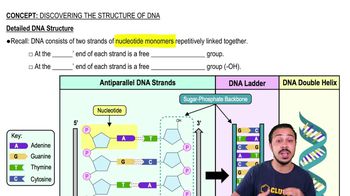
How is a ribonucleotide different from a deoxyribonucleotide?
Verified step by step guidance1
Understand that both ribonucleotides and deoxyribonucleotides are the building blocks of nucleic acids, with ribonucleotides forming RNA and deoxyribonucleotides forming DNA.
Identify the three main components of a nucleotide: a nitrogenous base, a sugar molecule, and one or more phosphate groups.
Focus on the sugar component: in ribonucleotides, the sugar is ribose, which has a hydroxyl group (-OH) attached to the 2' carbon atom.
In deoxyribonucleotides, the sugar is deoxyribose, which lacks the hydroxyl group at the 2' carbon, having only a hydrogen atom (-H) instead.
Recognize that this difference in the sugar molecule (presence or absence of the 2' hydroxyl group) is the key structural distinction between ribonucleotides and deoxyribonucleotides.

Verified video answer for a similar problem:
This video solution was recommended by our tutors as helpful for the problem above.
Video duration:
1mWas this helpful?
Key Concepts
Here are the essential concepts you must grasp in order to answer the question correctly.
Structure of Nucleotides
Nucleotides are the building blocks of nucleic acids, composed of a sugar, a phosphate group, and a nitrogenous base. The sugar component differs between ribonucleotides and deoxyribonucleotides, which is key to their function and structure.
Recommended video:
Guided course
Detailed DNA Structure
Difference Between Ribose and Deoxyribose
Ribonucleotides contain ribose sugar, which has a hydroxyl group (-OH) attached to the 2' carbon, whereas deoxyribonucleotides contain deoxyribose sugar, lacking the 2' hydroxyl group and having only a hydrogen atom. This small difference affects the stability and function of RNA and DNA.
Recommended video:
Guided course
Reviewing the Different Types of Microscopes
Role in RNA and DNA
Ribonucleotides are the monomers of RNA, which is typically single-stranded and involved in protein synthesis and regulation. Deoxyribonucleotides form DNA, which is double-stranded and stores genetic information. The sugar difference influences the overall structure and chemical properties of these nucleic acids.
Recommended video:
Guided course
1) RNA Processing
Related Practice
Textbook Question
1258
views
Textbook Question
Label the following as a biological, chemical, or physical mutagen:
UV radiation:
Transposons:
Cigarette smoke:
Viruses:
X-rays:
Plasmids:
Alcohol:
1463
views
Textbook Question
For the lactose operon to be “on” and actively transcribed, ___________ must be present and ___________ must be absent.
1546
views
Textbook Question
What would the likely consequence be if a gene’s promoter was deleted or severely mutated?
1461
views
Textbook Question
Assume you have the DNA sequence 3'-ACGTATCCAGCAGCTCCACCAA-5'.
Use the genetic code table found in the chapter to answer the following questions:
a. What would the complementary DNA sequence be?
b. What would the corresponding mRNA sequence be?
c. Could the mRNA sequence you generated be translated? Why or why not?
1321
views
Textbook Question
Why are the terms gene expression and protein synthesis often used interchangeably?
1573
views
