
Textbook Question
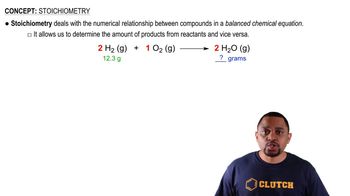
Calculate the theoretical yield of the product (in moles) for each initial amount of reactants.
Ti(s) + 2 Cl2(g) → TiCl4(s)
a. 4 mol Ti, 4 mol Cl2
b. 7 mol Ti, 17 mol Cl2
c. 12.4 mol Ti, 18.8 mol Cl2
1693
views

 Verified step by step guidance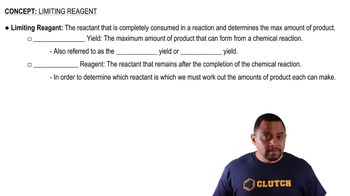
 01:30
01:30
 01:16
01:16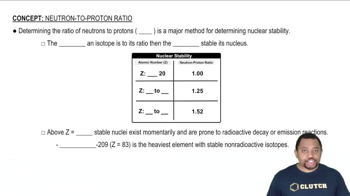 02:14
02:14Calculate the theoretical yield of the product (in moles) for each initial amount of reactants.
Ti(s) + 2 Cl2(g) → TiCl4(s)
a. 4 mol Ti, 4 mol Cl2
b. 7 mol Ti, 17 mol Cl2
c. 12.4 mol Ti, 18.8 mol Cl2
Consider the reaction: 4 HCl(g) + O2(g) → 2 H2O(g) + 2 Cl2(g) Each molecular diagram represents an initial mixture of reactants. How many molecules of Cl2 form from the reaction mixture that produces the greatest amount of products?
For each of the acid–base reactions, calculate the mass (in grams) of each acid necessary to completely react with and neutralize 4.85 g of the base. b. 2 HNO3(aq) + Ca(OH)2(aq) → 2 H2O(l) + Ca(NO3)2(aq)
Find the limiting reactant for each initial amount of reactants.
2 Na(s) + Br2(g) → 2 NaBr(s)
a. 2 mol Na, 2 mol Br2
b. 1.8 mol Na, 1.4 Br2
c. 2.5 mol Na, 1 mol Br2
d. 12.6 mol Na, 6.9 mol Br2
Consider the reaction: 2 CH3OH(g) + 3 O2(g) → 2 CO2(g) + 4 H2O(g) Each of the molecular diagrams represents an initial mixture of the reactants. How many CO2 molecules form from the reaction mixture that produces the greatest amount of products?