
The Chemistry and Life box in Section 6.7 described the techniques called NMR and MRI. (a) Instruments for obtaining MRI data are typically labeled with a frequency, such as 600 MHz. In what region of the electromagnetic spectrum does a photon with this frequency belong?
Ch.6 - Electronic Structure of Atoms
Brown14th EditionChemistry: The Central ScienceISBN: 9780134414232Not the one you use?Change textbook
Chapter 6, Problem 103
Scientists have speculated that element 126 might have a moderate stability, allowing it to be synthesized and characterized. Predict what the condensed electron configuration of this element might be.
Verified step by step guidance1
insert step 1> Start by identifying the position of element 126 in the periodic table. It is in the 8th period and belongs to the superactinide series, which follows the actinides.
insert step 2> Determine the electron configuration of the last known element, which is element 118 (Oganesson, Og). Its electron configuration is [Rn] 5f^{14} 6d^{10} 7s^{2} 7p^{6}.
insert step 3> Continue filling the electron orbitals following the Aufbau principle, which states that electrons fill orbitals starting from the lowest energy level to the highest.
insert step 4> After element 118, the next electrons will fill the 8s orbital, then the 5g orbital, and then the 6f orbital.
insert step 5> Predict the condensed electron configuration for element 126 by adding electrons to these orbitals, considering the order of filling: [Og] 8s^{2} 5g^{18} 6f^{4}.

Verified video answer for a similar problem:
This video solution was recommended by our tutors as helpful for the problem above.
Video duration:
4mWas this helpful?
Key Concepts
Here are the essential concepts you must grasp in order to answer the question correctly.
Electron Configuration
Electron configuration describes the distribution of electrons in an atom's orbitals. It follows the Aufbau principle, which states that electrons fill orbitals starting from the lowest energy level to the highest. Understanding electron configuration is crucial for predicting the chemical properties and reactivity of an element.
Recommended video:
Guided course
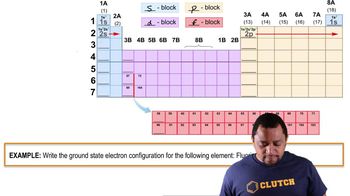
Electron Configuration Example
Periodic Table and Element Position
The periodic table organizes elements based on their atomic number and electron configurations. Element 126, being a hypothetical element, would be located in the superheavy region of the table, likely in the p-block. Its position helps predict its electron configuration and potential chemical behavior.
Recommended video:
Guided course
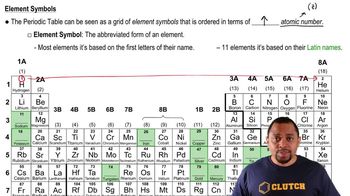
Periodic Table History
Stability of Superheavy Elements
Superheavy elements, like element 126, are theorized to exhibit unique stability due to relativistic effects and nuclear forces. These effects can influence their electron configurations and chemical properties, making them different from lighter elements. Understanding these factors is essential for predicting the behavior of such elements.
Recommended video:
Guided course
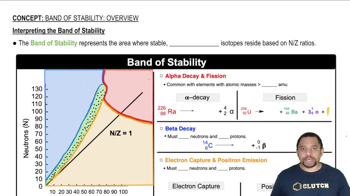
Intepreting the Band of Stability
Related Practice
Textbook Question
Textbook Question
In the experiment shown schematically below, a beam of neutral atoms is passed through a magnetic field. Atoms that have unpaired electrons are deflected in different directions in the magnetic field depending on the value of the electron spin quantum number. In the experiment illustrated, we envision that a beam of hydrogen atoms splits into two beams. (a) What is the significance of the observation that the single beam splits into two beams?
415
views
Textbook Question
Using the periodic table as a guide, write the condensed electron configuration and determine the number of unpaired electrons for the ground state of (a) Cl (b) Al (c) Zr (d) As (e) Sb (f) W.
573
views
