Which postulate of the kinetic molecular theory breaks down under conditions of high pressure? Explain.
Ch.5 - Gases
Chapter 5, Problem 90
The graph shows the distribution of molecular velocities for the same molecule at two different temperatures (T1 and T2). Which temperature is greater? Explain.

Verified step by step guidance1
Observe the graph showing the distribution of molecular velocities for the same molecule at two different temperatures, T1 (blue) and T2 (red).
Note that the x-axis represents molecular velocity (m/s) and the y-axis represents the relative number of molecules.
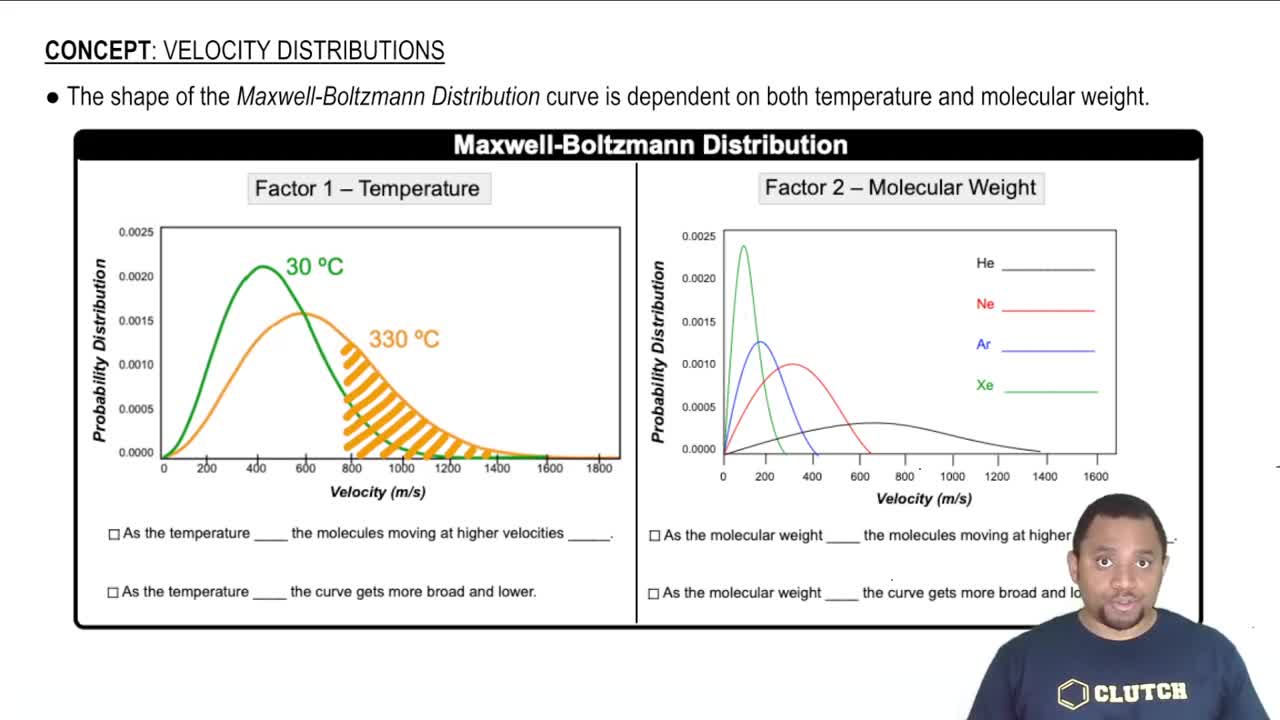
Understand that at higher temperatures, the distribution of molecular velocities broadens and shifts to higher velocities.
Compare the two curves: the red curve (T2) is broader and shifted to higher velocities compared to the blue curve (T1).
Conclude that T2 is the higher temperature because the distribution of molecular velocities is broader and shifted to higher velocities compared to T1.

Verified video answer for a similar problem:
This video solution was recommended by our tutors as helpful for the problem above.
Video duration:
3mWas this helpful?
Key Concepts
Here are the essential concepts you must grasp in order to answer the question correctly.
Kinetic Molecular Theory
The Kinetic Molecular Theory explains the behavior of gases in terms of particles in constant motion. It posits that the temperature of a gas is directly related to the average kinetic energy of its molecules. As temperature increases, the average velocity of the molecules also increases, leading to a broader distribution of molecular speeds.
Recommended video:
Guided course
Kinetic Molecular Theory
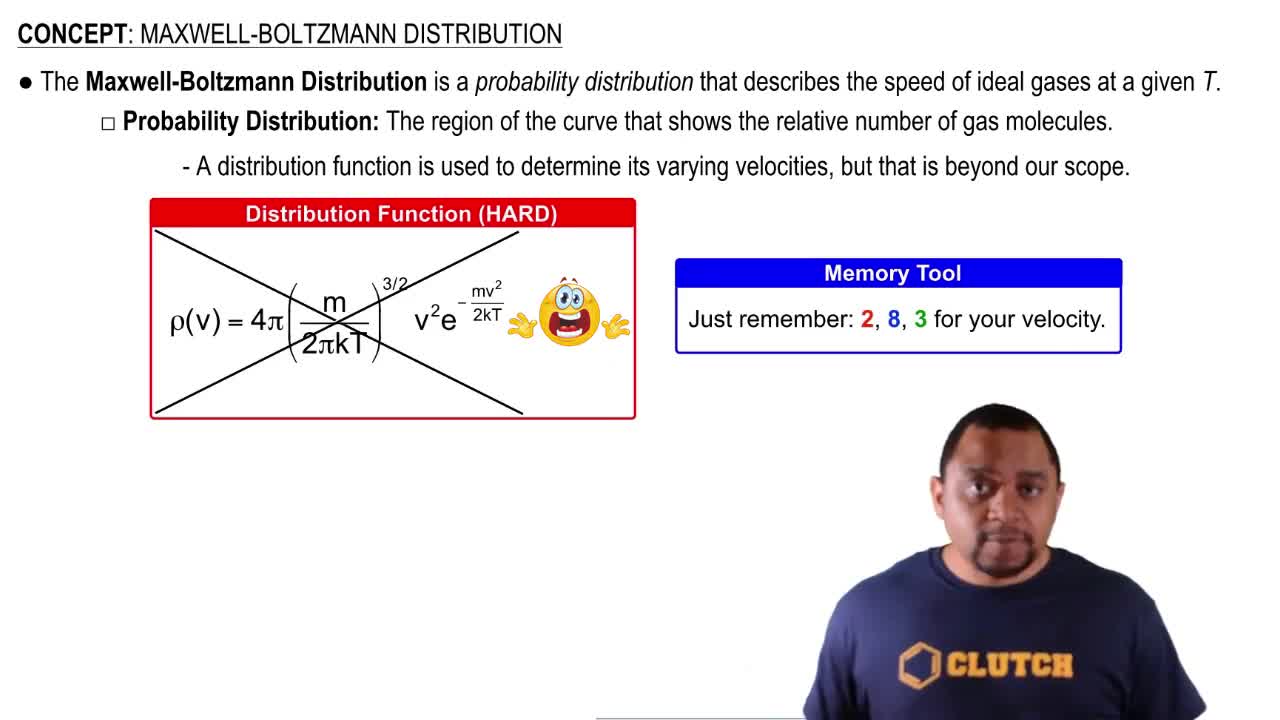
Maxwell-Boltzmann Distribution
The Maxwell-Boltzmann distribution describes the distribution of speeds among molecules in a gas. It shows that at higher temperatures, the distribution curve shifts to higher velocities, indicating that more molecules have higher kinetic energy. The peak of the curve represents the most probable speed of the molecules, which shifts to the right as temperature increases.
Recommended video:
Guided course
Maxwell-Boltzmann Distribution
Temperature and Molecular Velocity
Temperature is a measure of the average kinetic energy of the molecules in a substance. In the context of the graph, the temperature associated with the red curve (T2) is greater than that of the blue curve (T1), as indicated by the broader distribution and higher average molecular velocities at T2. This relationship is crucial for understanding how temperature affects molecular motion.
Related Practice
Textbook Question
1232
views
Textbook Question
Use the van der Waals equation and the ideal gas equation to calculate the volume of 1.000 mol of neon at a pressure of 500.0 atm and a temperature of 355.0 K. Explain why the two values are different. (Hint: One way to solve the van der Waals equation for V is to use successive approximations. Use the ideal gas law to get a preliminary estimate for V.)
3749
views
Textbook Question
Calculate the ratio of effusion rates for Ar and Kr.
1313
views
Textbook Question
A sample of neon effuses from a container in 76 seconds. The same amount of an unknown noble gas requires 155 seconds. Identify the second gas.
1758
views
1
comments
Textbook Question
A sample of N2O effuses from a container in 42 seconds. How long will it take the same amount of gaseous I2 to effuse from the same container under identical conditions?
3361
views