Write a molecular equation for the precipitation reaction that occurs (if any) when each pair of aqueous solutions is mixed. If no reaction occurs, write 'NO REACTION.' a. potassium carbonate and lead(II) nitrate
Ch.4 - Chemical Quantities & Aqueous Reactions
Chapter 4, Problem 77
Write a molecular equation for the precipitation reaction that occurs (if any) when each pair of aqueous solutions is mixed. If no reaction occurs, write “NO REACTION.” 1. lithium sulfate and lead(II) acetate 2. strontium nitrate and potassium iodide
Verified step by step guidance1
Identify the ions present in each solution: Lithium sulfate (Li2SO4) dissociates into 2 Li^+ and SO4^2-. Lead(II) acetate (Pb(C2H3O2)2) dissociates into Pb^2+ and 2 C2H3O2^-. Strontium nitrate (Sr(NO3)2) dissociates into Sr^2+ and 2 NO3^-. Potassium iodide (KI) dissociates into K^+ and I^-.
Determine the possible combinations of cations and anions from the mixed solutions: For lithium sulfate and lead(II) acetate, the possible combinations are Li^+ with C2H3O2^- and Pb^2+ with SO4^2-. For strontium nitrate and potassium iodide, the possible combinations are Sr^2+ with I^- and K^+ with NO3^-.
Use solubility rules to determine if any of the new combinations form a precipitate: Lead(II) sulfate (PbSO4) is insoluble, so it will precipitate. All acetates, nitrates, and alkali metal salts are soluble, so no other precipitates form.
Write the balanced molecular equation for the reaction that forms a precipitate: For lithium sulfate and lead(II) acetate, the equation is Li2SO4(aq) + Pb(C2H3O2)2(aq) -> 2 LiC2H3O2(aq) + PbSO4(s). For strontium nitrate and potassium iodide, since no precipitate forms, write 'NO REACTION'.
Conclude with the final molecular equations: 1. Li2SO4(aq) + Pb(C2H3O2)2(aq) -> 2 LiC2H3O2(aq) + PbSO4(s). 2. NO REACTION.
Key Concepts
Here are the essential concepts you must grasp in order to answer the question correctly.
Precipitation Reactions
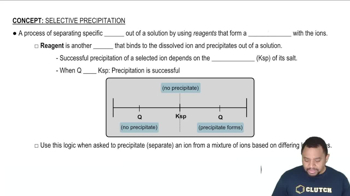
Precipitation reactions occur when two aqueous solutions react to form an insoluble solid, known as a precipitate. This process is driven by the formation of a compound that cannot remain dissolved in the solution, leading to the separation of the solid from the liquid. Identifying potential precipitates involves consulting solubility rules, which dictate the solubility of various ionic compounds in water.
Recommended video:
Guided course
Selective Precipitation
Molecular Equations
A molecular equation represents the reactants and products of a chemical reaction in their molecular form, showing the complete formulas of all reactants and products. In precipitation reactions, the molecular equation highlights the compounds involved before and after the reaction, allowing for a clear understanding of the substances that participate. Balancing the equation is essential to reflect the conservation of mass.
Solubility Rules
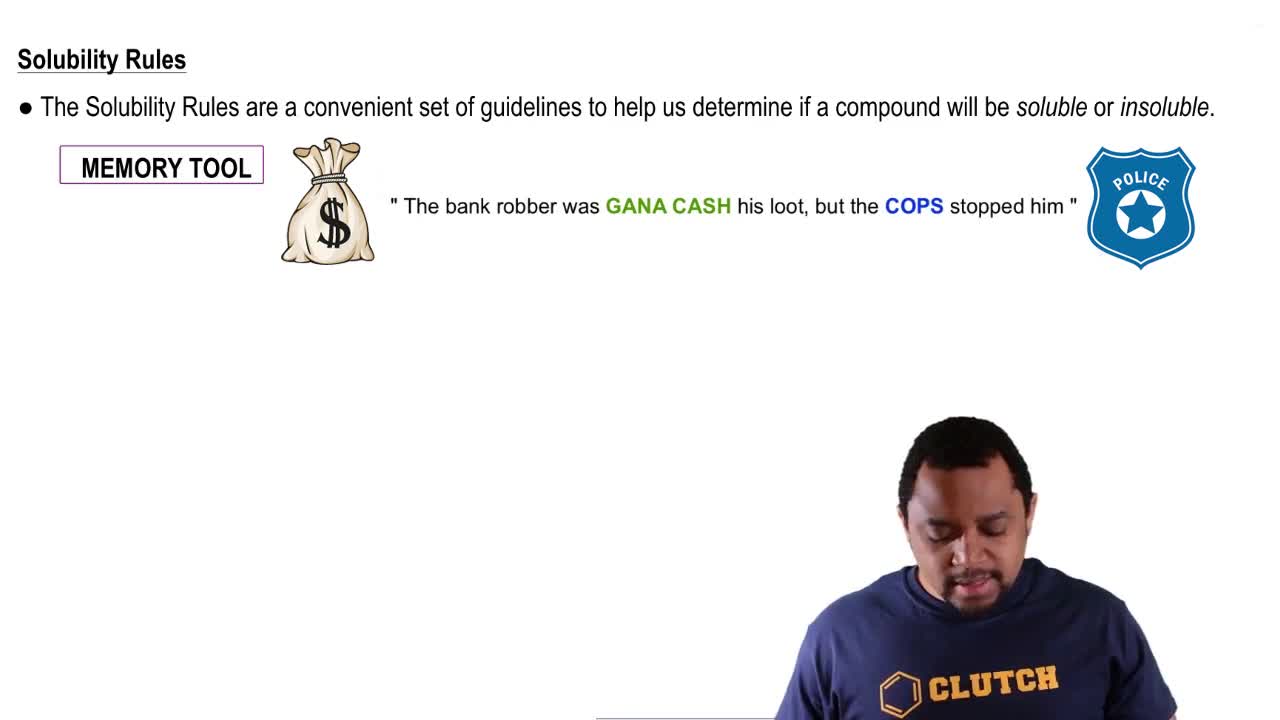
Solubility rules are guidelines that help predict whether a compound will dissolve in water or form a precipitate. These rules categorize ionic compounds based on their solubility, indicating which ions are generally soluble or insoluble in aqueous solutions. Understanding these rules is crucial for determining the outcome of mixing different ionic solutions, as they dictate whether a reaction will produce a precipitate or result in no reaction.
Recommended video:
Guided course
Solubility Rules
Related Practice
Textbook Question
1107
views
Textbook Question
Write a molecular equation for the precipitation reaction that occurs (if any) when each pair of aqueous solutions is mixed. If no reaction occurs, write 'NO REACTION.' c. copper(II) nitrate and magnesium sulfide
1654
views
Textbook Question
Complete and balance each equation. If no reaction occurs, write 'NO REACTION.' c. CrBr2(aq) + Na2CO3(aq) →
415
views
Textbook Question
Complete and balance each equation. If no reaction occurs, write 'NO REACTION.' a. NaNO3(aq) + KCl(aq) →
2418
views
2
rank
Textbook Question
Write balanced complete ionic and net ionic equations for each reaction. b. MgS(aq) + CuCl2(aq) → CuS(s) + MgCl2(aq)
677
views