Ch.7 - Covalent Bonding and Electron-Dot Structures
McMurry - Chemistry 8th Edition
McMurry8th EditionChemistryISBN: 9781292336145Not the one you use?Change textbook
Chapter 7, Problem 91

Draw three resonance structures for sulfur tetroxide, SO4, whose connections are shown below. (This is a neutral mol-ecule; it is not a sulfate ion.) Assign formal charges to the atoms in each structure.

Verified step by step guidance
1
Draw the skeletal structure of SO_4 with sulfur (S) in the center and four oxygen (O) atoms surrounding it.
For the first resonance structure, create a double bond between sulfur and one of the oxygen atoms, and single bonds with the other three oxygens. Assign formal charges: sulfur will have a formal charge of +2, the double-bonded oxygen will have a formal charge of 0, and each single-bonded oxygen will have a formal charge of -1.
For the second resonance structure, move the double bond to a different oxygen atom, keeping the other bonds as single bonds. Recalculate the formal charges: sulfur will still have a formal charge of +2, the new double-bonded oxygen will have a formal charge of 0, and the remaining single-bonded oxygens will each have a formal charge of -1.
For the third resonance structure, move the double bond to another different oxygen atom, maintaining single bonds with the rest. Again, recalculate the formal charges: sulfur will have a formal charge of +2, the new double-bonded oxygen will have a formal charge of 0, and the remaining single-bonded oxygens will each have a formal charge of -1.
Review all three resonance structures to ensure that the formal charges are correctly assigned and that the overall charge of the molecule remains neutral.

Verified video answer for a similar problem:

This video solution was recommended by our tutors as helpful for the problem above.
Video duration:
5m
Was this helpful?

Key Concepts

Here are the essential concepts you must grasp in order to answer the question correctly.

Resonance Structures

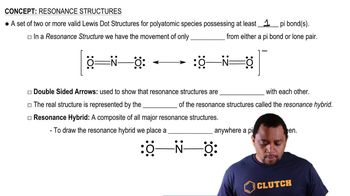
Resonance structures are different ways of drawing the same molecule that illustrate the delocalization of electrons. In resonance, the actual structure of the molecule is a hybrid of these forms, which helps to represent the distribution of electrons more accurately. For sulfur tetroxide (SO4), multiple resonance structures can be drawn to show how the double bonds and lone pairs can be arranged differently while maintaining the same connectivity.
Recommended video:
Guided course
01:42
Resonance Structures

Formal Charge

Formal charge is a theoretical charge assigned to an atom in a molecule, calculated based on the number of valence electrons, the number of non-bonding electrons, and half the number of bonding electrons. It helps in determining the most stable resonance structure, as the best structure typically has the lowest formal charges on the atoms. In the case of SO4, calculating formal charges for each atom in the resonance structures is essential to assess their stability.
Recommended video:
Guided course
01:53
Formal Charge

Lewis Structures

Lewis structures are diagrams that represent the bonding between atoms in a molecule and the lone pairs of electrons that may exist. They provide a visual representation of the molecule's structure, including how atoms are connected and the distribution of electrons. For sulfur tetroxide, drawing the correct Lewis structure is the first step in identifying possible resonance forms and understanding the molecule's overall geometry and electron distribution.
Recommended video:
Guided course
04:28
Lewis Dot Structures: Ions