
Classify each of the listed properties of ozone (a pollutant in the lower atmosphere but part of a protective shield against UV light in the upper atmosphere) as physical or chemical. a. bluish color b. pungent odor c. very reactive d. decomposes on exposure to ultraviolet light e. gas at room temperature
Ch.1 - Matter, Measurement & Problem Solving
Chapter 1, Problem 42
Determine whether each molecular diagram represents a pure substance or a mixture. If it represents a pure substance, classify the substance as an element or a compound. If it represents a mixture, classify the mixture as homogeneous or heterogeneous.

Verified step by step guidance1
Observe the molecular diagrams carefully to identify the types of particles present in each diagram.
For Diagram I, note that all particles are identical green spheres, indicating a pure substance. Since there is only one type of atom, classify it as an element.
For Diagram II, observe that there are two types of particles: red and yellow spheres bonded together in pairs. This indicates a pure substance composed of two different elements, classifying it as a compound.
For Diagram III, notice the presence of different types of particles: blue, black, purple, and grey spheres, some bonded and some not. This indicates a mixture. Since the particles are uniformly distributed, classify it as a homogeneous mixture.
Summarize the classifications: Diagram I is a pure substance (element), Diagram II is a pure substance (compound), and Diagram III is a homogeneous mixture.

Verified video answer for a similar problem:
This video solution was recommended by our tutors as helpful for the problem above.
Video duration:
1mWas this helpful?
Key Concepts
Here are the essential concepts you must grasp in order to answer the question correctly.
Pure Substances
A pure substance consists of only one type of particle, which can be either an element or a compound. Elements are made up of a single type of atom, while compounds consist of two or more different types of atoms chemically bonded together. In the molecular diagrams, pure substances will show uniformity in particle type and arrangement.
Recommended video:
Guided course
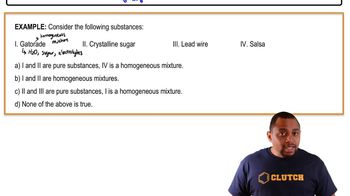
Classification of Matter Example
Mixtures
A mixture contains two or more different types of particles that are not chemically bonded. Mixtures can be classified as homogeneous, where the components are evenly distributed and indistinguishable, or heterogeneous, where the different components are easily identifiable. The arrangement of particles in the diagrams will help determine if a mixture is homogeneous or heterogeneous.
Molecular Representation
Molecular diagrams visually represent the arrangement and types of particles in a substance. The colors and shapes of the particles in the diagrams indicate different elements or compounds. Analyzing these representations allows for the classification of substances as pure or mixtures, and further categorization into elements, compounds, homogeneous, or heterogeneous mixtures.
Recommended video:
Guided course
Molecular Polarity
Related Practice
Textbook Question
1085
views
Textbook Question
Classify each property as physical or chemical. a. the boiling point of ethyl alcohol b. the temperature at which dry ice evaporates c. the tendency of iron to rust d. the color of gold
622
views
Textbook Question
Classify each change as physical or chemical. a. Natural gas burns in a stove. b. The liquid propane in a gas grill evaporates because the valve was left open. c. The liquid propane in a gas grill burns in a flame. d. A bicycle frame rusts on repeated exposure to air and water.
863
views
Textbook Question
Classify each substance as a pure substance or a mixture. If it is a pure substance, classify it as an element or a compound. If it is a mixture, classify it as homogeneous or heterogeneous. a. sweat b. carbon dioxide c. aluminum d. vegetable soup
2914
views
