Choose the larger atom in each pair. a. Sn or Si b. Br or Ga c. Sn or Bi d. Se or Sn
Ch.8 - Periodic Properties of the Elements
Chapter 8, Problem 64
Arrange these elements in order of decreasing atomic radius: Cs, Pb, Sb, Se, S.
Verified step by step guidance1
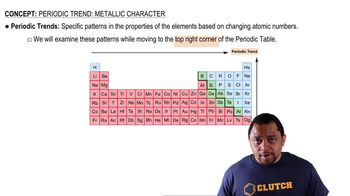
Identify the periodic trend for atomic radius: Atomic radius generally increases as you move down a group and decreases as you move across a period from left to right.
Locate each element on the periodic table: Cs (Cesium), Pb (Lead), Sb (Antimony), Se (Selenium), and S (Sulfur).
Determine the group and period for each element: Cs is in Group 1, Period 6; Pb is in Group 14, Period 6; Sb is in Group 15, Period 5; Se is in Group 16, Period 4; S is in Group 16, Period 3.
Compare the elements based on their positions: Elements in higher periods generally have larger atomic radii. Elements in the same period decrease in atomic radius from left to right.
Arrange the elements in order of decreasing atomic radius based on their positions and periodic trends.
Key Concepts
Here are the essential concepts you must grasp in order to answer the question correctly.
Atomic Radius
Atomic radius is a measure of the size of an atom, typically defined as the distance from the nucleus to the outermost electron shell. It generally increases down a group in the periodic table due to the addition of electron shells, while it decreases across a period from left to right due to increased nuclear charge, which pulls electrons closer to the nucleus.
Periodic Trends
Periodic trends refer to predictable patterns in the properties of elements as you move across or down the periodic table. Key trends include atomic radius, ionization energy, and electronegativity. Understanding these trends helps in predicting the behavior of elements, including their size and reactivity.
Recommended video:
Guided course
Periodic Trends
Group and Period Position
Elements are organized in groups (columns) and periods (rows) in the periodic table. Elements in the same group share similar properties and have the same number of valence electrons, while elements in the same period have the same number of electron shells. This organization is crucial for understanding atomic size, as elements in lower periods generally have larger atomic radii.
Recommended video:
Guided course
Lone Pair Positions
Related Practice
Textbook Question
715
views
Textbook Question
Write the electron configuration for each ion. b. Br-
891
views
Textbook Question
Write the electron configuration for each ion. a. O2-
712
views
Textbook Question
In Section 3.6, we estimated the effective nuclear charge on beryllium's valence electrons to be slightly greater than 2+. What would a similar treatment predict for the effective nuclear charge on boron's valence electrons? Would you expect the effective nuclear charge to be different for boron's 2s electrons compared to its 2p electron? In what way? (Hint: Consider the shape of the 2p orbital compared to that of the 2s orbital.)
1059
views
1
rank
Textbook Question
Choose the larger atom in each pair. a. Al or In b. Si or N c. P or Pb d. Si or Cl
1732
views
1
rank
Textbook Question
Write the electron configuration for each ion. c. Sr2+ d. Co3+ e. Cu2+