Which ions remain in solution, unreacted, after each of the following pairs of solutions is mixed? (c) ammonium phosphate and calcium chloride
Ch.4 - Reactions in Aqueous Solution
Brown14th EditionChemistry: The Central ScienceISBN: 9780134414232Not the one you use?Change textbook
Chapter 4, Problem 28
Separate samples of a solution of an unknown ionic compound are treated with dilute AgNO3, Pb1NO322, and BaCl2. Precipitates form in all three cases. Which of the following could be the anion of the unknown salt: Br-, CO32-, NO3-?
Verified step by step guidance1
Identify the possible reactions that could occur with each reagent: AgNO_3, Pb(NO_3)_2, and BaCl_2.
Consider the solubility rules for common ionic compounds to determine which anions form precipitates with the given cations.
For AgNO_3, determine which anions form insoluble silver salts, such as AgBr.
For Pb(NO_3)_2, determine which anions form insoluble lead salts, such as PbCO_3.
For BaCl_2, determine which anions form insoluble barium salts, such as BaCO_3.

Verified video answer for a similar problem:
This video solution was recommended by our tutors as helpful for the problem above.
Video duration:
2mWas this helpful?
Key Concepts
Here are the essential concepts you must grasp in order to answer the question correctly.
Precipitation Reactions
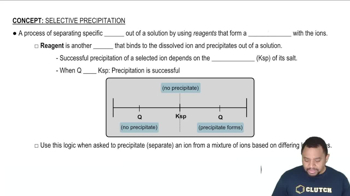
Precipitation reactions occur when two soluble ionic compounds react in solution to form an insoluble solid, known as a precipitate. In this case, the addition of AgNO3, Pb(NO3)2, and BaCl2 to the unknown ionic compound results in precipitates, indicating that the anion in the unknown compound must form insoluble salts with these cations.
Recommended video:
Guided course
Selective Precipitation
Solubility Rules
Solubility rules are guidelines that help predict whether a compound will dissolve in water. For example, silver (Ag+), lead (Pb2+), and barium (Ba2+) salts have specific solubility characteristics; AgBr and PbBr2 are insoluble, while BaCO3 is also insoluble. Understanding these rules is essential for determining which anions can form precipitates with the given cations.
Recommended video:
Guided course
Solubility Rules
Ionic Compounds and Anions
Ionic compounds consist of cations and anions held together by ionic bonds. The identity of the anion is crucial in predicting the behavior of the compound in solution. In this scenario, the possible anions Br-, CO32-, and NO3- must be evaluated based on their ability to form precipitates with the cations present in the reagents used.
Recommended video:
Guided course
Ionic Compounds Naming
Related Practice
Textbook Question
904
views
Textbook Question
Write balanced net ionic equations for the reactions that occur in each of the following cases. Identify the spectator ion or ions in each reaction.
(a) Ba(OH)2(aq) + FeCl3(aq) →
(b) ZnCl2(aq) + Cs2CO3(aq) →
638
views
1
rank
Textbook Question
State whether each of the following statements is true or false. Justify your answer in each case. (b) HCl is a weak acid.
330
views
Textbook Question
You know that an unlabeled bottle contains an aqueous solutionof one of the following: AgNO3, CaCl2, or Al21SO423. Afriend suggests that you test a portion of the solution withBa1NO322 and then with NaCl solutions. According to yourfriend's logic, which of these chemical reactions could occur,thus helping you identify the solution in the bottle?(a) Barium sulfate could precipitate. (b) Silver chloridecould precipitate. (c) Silver sulfate could precipitate.(d) More than one, but not all, of the reactions described inanswers a–c could occur. (e) All three reactions described inanswers a–c could occur.
1517
views
1
rank
Textbook Question
State whether each of the following statements is true or false. Justify your answer in each case. (a) Sulfuric acid is a monoprotic acid.
341
views
Textbook Question
Which ions remain in solution, unreacted, after each of the following pairs of solutions is mixed? (a) potassium carbonate and magnesium sulfate
646
views