Ch. 3 - Polynomial and Rational Functions
Lial - College Algebra 13th Edition
Lial13th EditionCollege AlgebraISBN: 9780136881063Not the one you use?Change textbook
Chapter 4, Problem 8

Provide a short answer to each question. Is ƒ(x)=1/x an even or an odd function? What symmetry does its graph exhibit?

Verified step by step guidance
1
Recall the definitions: A function \( f(x) \) is even if \( f(-x) = f(x) \) for all \( x \) in the domain, and it is odd if \( f(-x) = -f(x) \) for all \( x \) in the domain.
Start by finding \( f(-x) \) for the given function \( f(x) = \frac{1}{x} \). Substitute \( -x \) into the function: \( f(-x) = \frac{1}{-x} = -\frac{1}{x} \).
Compare \( f(-x) \) with \( f(x) \) and \( -f(x) \): since \( f(-x) = -\frac{1}{x} = -f(x) \), the function satisfies the condition for being an odd function.
Because \( f(x) \) is odd, its graph exhibits symmetry about the origin. This means if you rotate the graph 180 degrees around the origin, it looks the same.
Summarize: \( f(x) = \frac{1}{x} \) is an odd function and its graph has origin symmetry.

Verified video answer for a similar problem:

This video solution was recommended by our tutors as helpful for the problem above.
Video duration:
2m
Was this helpful?

Key Concepts

Here are the essential concepts you must grasp in order to answer the question correctly.

Even and Odd Functions

A function is even if f(-x) = f(x) for all x in its domain, meaning its graph is symmetric about the y-axis. A function is odd if f(-x) = -f(x), indicating symmetry about the origin. Determining whether a function is even or odd helps understand its symmetry properties.
Recommended video:
06:08
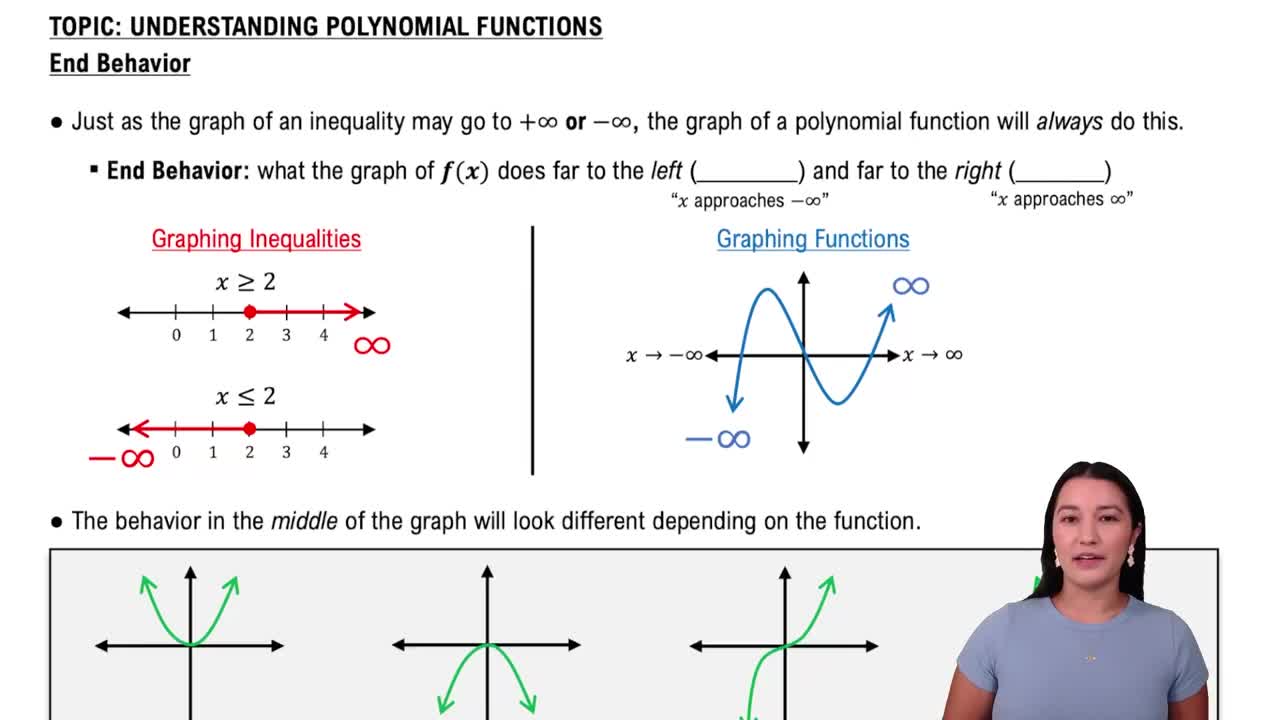
End Behavior of Polynomial Functions

Function Symmetry

Symmetry in functions refers to how their graphs mirror across certain lines or points. Even functions have y-axis symmetry, while odd functions have origin symmetry. Recognizing symmetry helps in graphing and analyzing function behavior efficiently.
Recommended video:
4:56
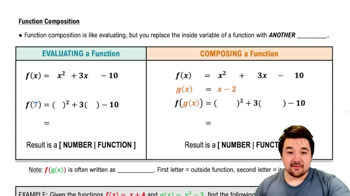
Function Composition

Reciprocal Function Characteristics

The function f(x) = 1/x is a reciprocal function defined for all x ≠ 0. It is known to be an odd function because substituting -x yields f(-x) = -1/x = -f(x). Its graph exhibits origin symmetry, with branches in the first and third quadrants.
Recommended video:
4:56
Function Composition
Related Practice
Textbook Question

Use the graph to solve each equation or inequality. Use interval notation where appropriate. 2(x-2) / {(x-1)(x-3)} < 0

502
views
Textbook Question

Use synthetic division to perform each division. (5x4 +5x3 + 2x2 - x-3) / x+1

524
views
Textbook Question

Solve each problem. During the course of a year, the number of volunteers available to run a food bank each month is modeled by V(x)V(x), where V(x)=2x232x+150V(x)=2x^2-32x+150 between the months of January and August. Here x is time in months, with x=1 representing January. From August to December, V(x)V(x) is modeled by V(x)=31x226V(x)=31x-226. Find the number of volunteers in each of the following months. Sketch a graph of y=V(x)y=V(x) for January through December. In what month are the fewest volunteers available?

724
views
Textbook Question

Determine whether each statement is true or false. If false, explain why. The product of a complex number and its conjugate is always a real number.

550
views
Textbook Question

Graph each function. Determine the largest open intervals of the domain over which each function is (a) increasing or (b) decreasing. ƒ(x)=2x4

935
views
Textbook Question

Solve each problem. During the course of a year, the number of volunteers available to run a food bank each month is modeled by V(x)V(x), where V(x)=2x232x+150V(x)=2x^2-32x+150 between the months of January and August. Here x is time in months, with x=1 representing January. From August to December, V(x)V(x) is modeled by V(x)=31x226V(x)=31x-226. Find the number of volunteers in each of the following months.

December

517
views