Evaluate each expression without using a calculator. log7 √7
Verified step by step guidance
1
Recognize that the expression is \( \log_7 \sqrt{7} \), which means the logarithm base 7 of the square root of 7.
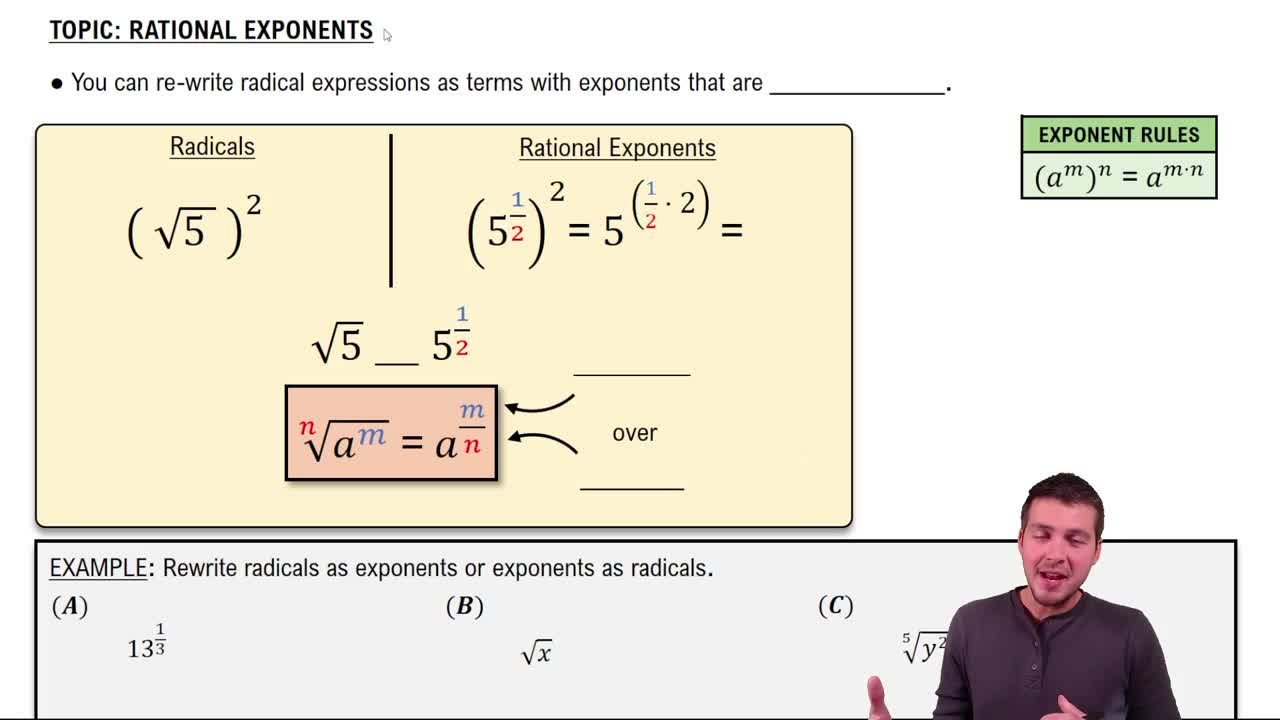
Rewrite the square root of 7 using an exponent: \( \sqrt{7} = 7^{\frac{1}{2}} \).
Substitute this back into the logarithm: \( \log_7 7^{\frac{1}{2}} \).
Use the logarithm power rule, which states \( \log_b (a^c) = c \cdot \log_b a \), to simplify: \( \log_7 7^{\frac{1}{2}} = \frac{1}{2} \cdot \log_7 7 \).
Since \( \log_7 7 = 1 \) (because any log base of itself is 1), the expression simplifies to \( \frac{1}{2} \cdot 1 = \frac{1}{2} \).
Verified video answer for a similar problem:
This video solution was recommended by our tutors as helpful for the problem above
Video duration:
1m
Play a video:
0 Comments
Key Concepts
Here are the essential concepts you must grasp in order to answer the question correctly.
Properties of Logarithms
Logarithms have specific properties that simplify expressions, such as the product, quotient, and power rules. For example, the power rule states that log_b(a^c) = c * log_b(a), which helps in rewriting and evaluating logarithmic expressions without a calculator.
A square root can be expressed as an exponent of 1/2, so √7 is equivalent to 7^(1/2). This conversion allows the use of exponent rules within logarithmic expressions, making it easier to simplify and evaluate the expression.
The logarithm of a base to itself is always 1, meaning log_b(b) = 1. This fundamental fact is essential when simplifying expressions like log_7(7^(1/2)), as it directly leads to the evaluation of the logarithm.

 1:51 minutes
 Verified step by step guidance
 5:36
5:36