Recognize that the equation is given in logarithmic form: \(\log_{4} x = 3\).
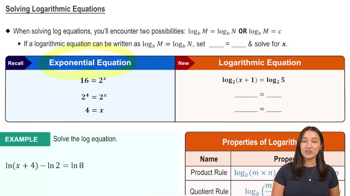
Recall the definition of a logarithm: \(\log_{a} b = c\) means \(a^{c} = b\).
Rewrite the equation \(\log_{4} x = 3\) in its equivalent exponential form: \$4^{3} = x$.
Calculate the value of \$4^{3}$ by multiplying 4 by itself three times (do not provide the final number here).
Conclude that the solution for \(x\) is the value obtained from \$4^{3}$.
Verified video answer for a similar problem:
This video solution was recommended by our tutors as helpful for the problem above
Video duration:
2m
Play a video:
0 Comments
Key Concepts
Here are the essential concepts you must grasp in order to answer the question correctly.
Definition of Logarithms
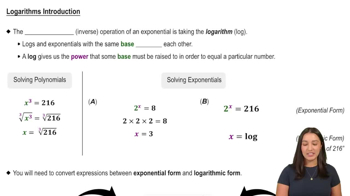
A logarithm answers the question: to what exponent must the base be raised to produce a given number? For log₄ x = 3, it means 4 raised to the power 3 equals x. Understanding this definition allows you to rewrite logarithmic equations in exponential form.
Converting Logarithmic Equations to Exponential Form
To solve log₄ x = 3, rewrite it as an exponential equation: 4³ = x. This conversion simplifies solving for x by removing the logarithm and using basic exponentiation, making it easier to find the solution.
Knowing how to compute powers, such as 4³, is essential. Exponentiation involves multiplying the base by itself as many times as the exponent indicates. Here, 4³ = 4 × 4 × 4 = 64, which gives the solution to the equation.

 2:04 minutes
 Verified step by step guidance
 7:30
7:30